
If you’ve ever followed the UK stock market, watched the financial news or considered investing, you’ve probably come across the term FTSE 100. It is one of the most recognised financial benchmarks in the United Kingdom and is often used to measure the overall performance of the country’s largest publicly listed companies.
Thank you for reading this post, don't forget to subscribe!But the FTSE 100 is much more than a number shown on business news channels. It influences pension funds, Stocks and Shares ISAs, investment portfolios and even how international investors view the strength of the UK market. When the index rises or falls, it reflects changes affecting many of Britain’s biggest businesses and can provide valuable insight into the wider economy.
Whether you’re completely new to investing or looking to understand how the UK stock market works, this guide explains everything you need to know about the FTSE 100 in simple language. We’ll cover how the index works, how companies qualify, what causes it to rise or fall and why it matters to everyday UK investors.
Quick Answer
What is the FTSE 100?
The FTSE 100 is the UK’s leading stock market index, tracking the performance of the 100 largest companies listed on the London Stock Exchange by market capitalisation. Managed by FTSE Russell, the index is widely used as a benchmark for the UK stock market and is followed by investors, pension funds and financial institutions around the world.
FTSE 100 at a Glance
| Feature | Details |
|---|---|
| Full Name | Financial Times Stock Exchange 100 Index |
| Launched | 3 January 1984 |
| Country | United Kingdom |
| Exchange | London Stock Exchange |
| Number of Companies | 100 |
| Maintained By | FTSE Russell |
| Currency | Pound Sterling (£) |
| Review Frequency | Quarterly |
| Purpose | Tracks the largest UK-listed companies |
| Used By | Investors, pension funds, fund managers and analysts |
Did You Know?
Many people assume the FTSE 100 represents only the UK economy. In reality, a large proportion of the revenue earned by FTSE 100 companies comes from overseas markets. This means global events such as oil prices, US interest rates or economic growth in Asia can influence the index just as much as developments within the UK.
What Is the FTSE 100?
The FTSE 100 is the benchmark index of the UK stock market, representing the 100 largest companies listed on the London Stock Exchange based on market capitalisation. It is designed to provide investors with a snapshot of how the UK’s biggest publicly traded businesses are performing.
Companies within the index come from a wide range of industries, including banking, pharmaceuticals, energy, mining, consumer goods and telecommunications. Well-known businesses such as AstraZeneca, HSBC, Shell, Unilever and Barclays have all been members of the FTSE 100.
Unlike a list of the biggest UK employers or the most profitable companies, the FTSE 100 is based on market value. A company’s position changes as its share price rises or falls, and the index is reviewed every quarter to ensure it continues to represent the largest listed businesses.
In Simple Terms
Think of the FTSE 100 as the Premier League of the UK stock market. Only the largest publicly listed companies qualify, and businesses can move into or out of the index depending on their size and market performance.
Why This Matters
Understanding what the FTSE 100 represents helps investors measure market performance, compare investments and gain insight into the health of many of the UK’s largest listed companies.
Why Is the FTSE 100 Important?
The FTSE 100 plays an important role in the UK’s financial system because it acts as a benchmark for investors, fund managers and financial institutions. Rather than analysing hundreds of individual companies, many people look at the movement of the FTSE 100 to understand the overall direction of the UK stock market.
Its importance extends beyond professional investors. Millions of people are exposed to the FTSE 100 through workplace pensions, Stocks and Shares ISAs and investment funds. Many index funds and exchange-traded funds (ETFs) are designed to track the performance of the FTSE 100, meaning changes in the index can influence the value of long-term savings.
The FTSE 100 is also watched closely by economists and policymakers because it reflects investor confidence, business performance and the impact of major economic events.
Why It Matters to You
Even if you never buy individual shares, your pension or investment fund may already include FTSE 100 companies. Understanding how the index works can help you make more informed financial decisions over the long term.
How Does the FTSE 100 Work?
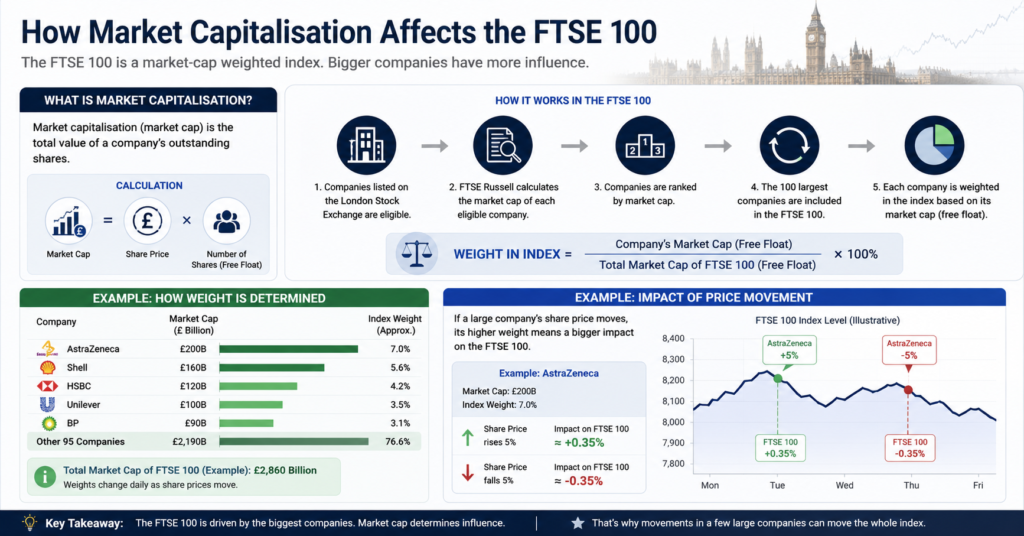
The FTSE 100 is calculated using the total market capitalisation of its constituent companies. Market capitalisation is calculated by multiplying a company’s share price by the number of shares available to investors (known as the free float).
Companies with a larger market value have a greater influence on the movement of the index. This means that when a major constituent such as Shell or AstraZeneca experiences a significant change in its share price, the overall FTSE 100 is more likely to move.
The composition of the FTSE 100 is reviewed every quarter by FTSE Russell. Companies that no longer rank among the largest listed firms may be removed, while growing businesses can be promoted from the FTSE 250. This process ensures that the index continues to reflect the UK’s leading publicly traded companies.
Because many FTSE 100 companies operate globally, the index is influenced by both domestic and international events. Changes in commodity prices, exchange rates, central bank decisions and corporate earnings can all have a significant impact on daily market performance.
In Simple Terms
The larger a company is, the greater its impact on the FTSE 100. When the biggest companies rise or fall, the index usually follows.
How Are Companies Selected for the FTSE 100?
The FTSE 100 is not a fixed list of companies. It changes over time as businesses grow, shrink or experience significant changes in their market value. This ensures the index continues to represent the UK’s largest publicly traded companies.
The index is managed by FTSE Russell, which reviews its constituents every quarter. During these reviews, companies may be promoted into the FTSE 100 or removed if they no longer meet the required size criteria.
To qualify, a company must generally:
- Be listed on the London Stock Exchange.
- Meet FTSE Russell’s free-float requirements.
- Rank among the largest eligible companies by market capitalisation.
This regular review process keeps the FTSE 100 relevant and reflective of the current UK stock market.
Quick Answer
Companies are selected for the FTSE 100 based primarily on their market capitalisation and eligibility under FTSE Russell’s rules. The index is reviewed every quarter, allowing companies to move into or out of the FTSE 100 as their market value changes.
Example
Imagine a technology company listed in the FTSE 250 grows rapidly over several years. If its market value becomes large enough, it may be promoted to the FTSE 100 during the next quarterly review. Likewise, if an existing FTSE 100 company declines significantly in value, it could be replaced.
In Simple Terms
Think of the FTSE 100 like a football league. The strongest teams remain in the top division, while those that perform poorly can be replaced by rising teams from the league below.
Why This Matters
The changing composition of the FTSE 100 ensures that investors always have exposure to the UK’s largest listed businesses rather than a fixed list of companies.
The Largest Companies in the FTSE 100
Although the FTSE 100 contains exactly 100 companies, not every business has the same influence on the index. Larger companies have a greater weighting, meaning changes in their share prices have a bigger impact on the overall performance of the FTSE 100.
Below are some of the companies that have consistently been among the largest constituents.
| Company | Sector | Why It Matters |
|---|---|---|
| AstraZeneca | Healthcare | One of the largest companies in the index with global pharmaceutical operations. |
| Shell | Energy | Strongly influenced by global oil prices and commodity markets. |
| HSBC | Banking | Provides exposure to international banking and Asian markets. |
| Unilever | Consumer Goods | Owns globally recognised household brands. |
| BP | Energy | Major contributor to movements in the energy sector. |
| RELX | Information Services | Global provider of data and analytics solutions. |
| GSK | Healthcare | Large pharmaceutical company with international revenue. |
| Rio Tinto | Mining | Sensitive to commodity demand and global economic growth. |
| Barclays | Banking | Represents the UK financial sector. |
| Lloyds Banking Group | Banking | Closely linked to the domestic UK economy. |
Because these businesses have large market values, movements in just a handful of companies can influence the direction of the entire FTSE 100.
In Simple Terms
Imagine ten of the biggest companies as the “captains” of the index. If several of them perform strongly on the same day, the FTSE 100 is more likely to rise, even if many smaller companies record only modest gains or losses.
Why This Matters
Knowing which companies carry the greatest weight helps investors understand why the index sometimes moves sharply even when most shares show little change.
Which Sectors Dominate the FTSE 100?
The FTSE 100 is diversified across multiple industries, but certain sectors have a much greater influence than others.
Unlike some international stock indices that are heavily weighted towards technology companies, the FTSE 100 has significant exposure to energy, financial services, healthcare and consumer goods.
| Sector | Why It Matters |
|---|---|
| Energy | Driven by global oil and gas prices. |
| Banking | Influenced by interest rates and economic growth. |
| Healthcare | Often considered defensive during periods of market uncertainty. |
| Mining | Sensitive to commodity prices and global demand. |
| Consumer Goods | Includes companies with internationally recognised brands. |
| Insurance | Reflects financial market conditions and investment returns. |
| Telecommunications | Provides essential communication services with stable demand. |
Because of this sector mix, the FTSE 100 often behaves differently from indices such as the S&P 500 or NASDAQ.
For example, a rise in oil prices may support the FTSE 100 because of its large energy companies, while the same event may have a different impact on technology-focused indices.
Why This Matters
Understanding sector composition helps explain why the FTSE 100 reacts differently to global events compared with other major stock market indices.
How Can You Invest in the FTSE 100?
There are several ways to gain exposure to the FTSE 100, depending on your financial goals, investment experience and risk tolerance.
1. FTSE 100 ETFs
Exchange-Traded Funds (ETFs) track the performance of the FTSE 100 and trade on the stock market like ordinary shares. They are popular with investors seeking a low-cost way to diversify across the UK’s largest companies.
2. Index Funds
Index funds are designed to replicate the performance of the FTSE 100. They are commonly used for long-term investing and retirement planning because of their relatively low management costs.
3. Buying Individual Shares
Instead of investing in the entire index, some investors choose to buy shares in specific FTSE 100 companies such as BP, Shell or HSBC. While this offers greater flexibility, it also increases company-specific risk.
4. Stocks and Shares ISA
Many UK investors hold FTSE 100 investments within a Stocks and Shares ISA, allowing potential investment gains and income to be sheltered from UK tax, subject to current tax rules.
5. Pension Investments
Many workplace and personal pensions include funds that track or invest significantly in FTSE 100 companies, meaning millions of people already have indirect exposure to the index.
Comparison
| Investment Method | Suitable For | Risk Level |
|---|---|---|
| ETF | Beginners | Medium |
| Index Fund | Long-term investors | Medium |
| Individual Shares | Experienced investors | Higher |
| Stocks and Shares ISA | Tax-efficient investing | Medium |
| Pension Funds | Retirement planning | Medium |
Common Beginner Mistake
Many people believe buying shares in one FTSE 100 company means they are investing in the FTSE 100 itself.
This is incorrect.
Owning one company exposes you only to that business. Investing in an index fund or ETF provides exposure to a broad range of companies across different sectors.
Why This Matters
Choosing the right investment method depends on your financial objectives, time horizon and appetite for risk. Diversification through an index fund or ETF may reduce company-specific risk compared with investing in a single share.
What Moves the FTSE 100?
The FTSE 100 is influenced by a combination of domestic and international factors. Because many of its largest companies operate globally, movements in the index are often driven by events outside the UK as well as developments within the domestic economy.
The main factors include:
- Oil and commodity prices
- Bank of England interest rate decisions
- UK inflation data
- GDP growth
- Employment figures
- Corporate earnings
- Exchange rates, particularly the value of the pound
- Global economic conditions
- Political and geopolitical developments
FTSE 100 in Action
Imagine oil prices rise sharply because of geopolitical tensions.
The likely chain of events could look like this:
Oil prices rise
        ↓
BP and Shell shares gain
        ↓
Energy sector strengthens
        ↓
Banks and mining companies weaken
        ↓
FTSE 100 finishes little changed
This simple example shows why understanding the underlying drivers is often more useful than simply looking at whether the index finished higher or lower.
Why This Matters
Successful investors focus not only on what the market did, but also on why it moved. Understanding these relationships helps you interpret daily market news and make more informed investment decisions.
FTSE 100 vs FTSE 250 – What’s the Difference?
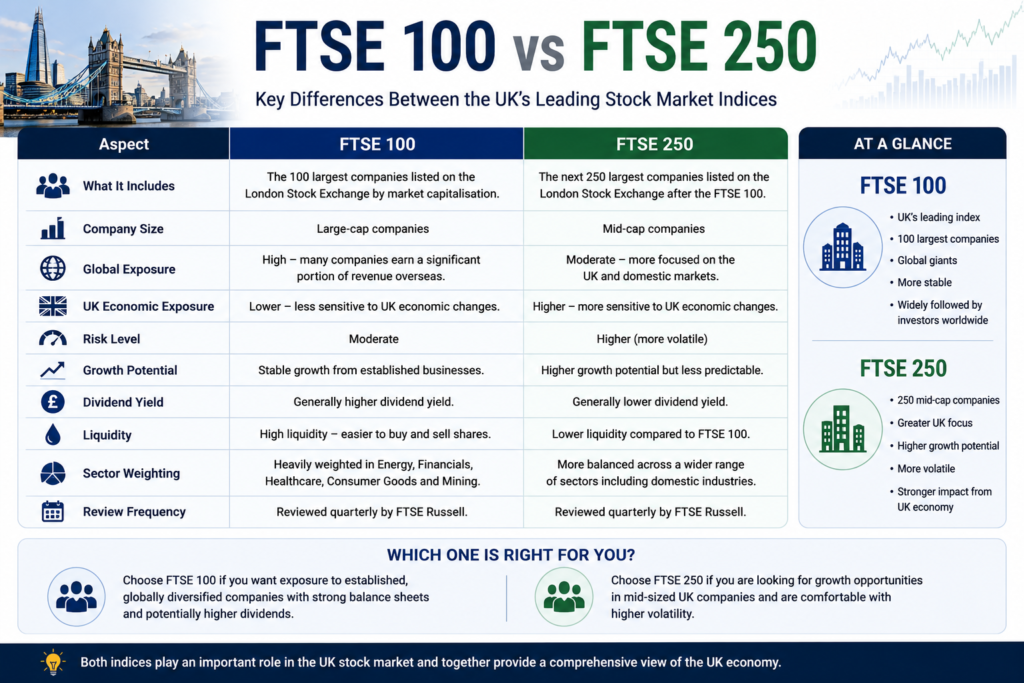
Although both indices represent companies listed on the London Stock Exchange, they track different parts of the UK market.
The FTSE 100 includes the 100 largest eligible companies by market capitalisation, while the FTSE 250 contains the next 250 largest companies after the FTSE 100. Together, these indices provide a broader picture of the UK equity market.
Many FTSE 100 companies generate a significant share of their revenue overseas, whereas FTSE 250 businesses often have a greater focus on the domestic UK economy. As a result, economic events within the UK may have a stronger effect on the FTSE 250 than on the FTSE 100.
Comparison Table
| Feature | FTSE 100 | FTSE 250 |
|---|---|---|
| Companies | 100 | Next 250 largest |
| Company Size | Large-cap | Mid-cap |
| Global Exposure | High | Moderate |
| UK Economic Exposure | Lower | Higher |
| Risk | Moderate | Higher |
| Growth Potential | Stable | Higher potential |
| Dividend Yield | Often higher | Often lower |
In Simple Terms
Think of the FTSE 100 as established global leaders, while the FTSE 250 is made up of medium-sized companies with greater potential for future growth but also higher volatility.
Benefits and Risks of Investing in the FTSE 100
Investing in the FTSE 100 offers several advantages, but it also involves risks that investors should understand.
Benefits
- Diversification across multiple industries.
- Exposure to some of the UK’s largest companies.
- Many companies pay regular dividends.
- Widely available through ETFs and index funds.
- Suitable for long-term investing.
Risks
- Market values can rise and fall.
- Global events can significantly influence the index.
- Heavy exposure to sectors such as energy and financial services.
- Currency movements can affect multinational companies.
- Past performance does not guarantee future returns.
Pros and Cons
| Pros | Cons |
|---|---|
| Diversified | Market volatility |
| Global companies | Economic uncertainty |
| Dividend income | Sector concentration |
| Easy to invest | No guaranteed returns |
| Long-term growth potential | Global risks |
Why This Matters
Understanding both the benefits and the risks helps investors set realistic expectations and make decisions that align with their financial goals.
Common Beginner Mistakes
Many new investors misunderstand how the FTSE 100 works. Avoiding these common mistakes can help you build a stronger foundation.
Mistake 1 – Assuming the FTSE 100 Represents the Entire UK Economy
Many FTSE 100 companies earn most of their revenue overseas. The index is influenced by global markets as much as domestic events.
Mistake 2 – Thinking Every Company Moves the Index Equally
Larger companies have a greater weighting, meaning they can influence the index more than smaller constituents.
Mistake 3 – Chasing Daily Market Moves
Short-term fluctuations are normal. Long-term investors often focus on broader trends rather than reacting to every market movement.
Mistake 4 – Ignoring Diversification
Buying one FTSE 100 company is not the same as investing in the whole index.
Mistake 5 – Investing Without Understanding Risk
Every investment carries risk. Investors should consider their financial goals, time horizon and risk tolerance before investing.
Frequently Asked Questions
What is the FTSE 100?
The FTSE 100 is the UK’s leading stock market index, tracking the 100 largest eligible companies listed on the London Stock Exchange by market capitalisation.
Who manages the FTSE 100?
The index is managed by FTSE Russell, which reviews its constituents every quarter.
How often is the FTSE 100 updated?
The index value changes continuously during market trading hours, while its constituent companies are formally reviewed every quarter.
Can companies leave the FTSE 100?
Yes. Companies can be promoted into or removed from the index depending on changes in market capitalisation and eligibility.
Is the FTSE 100 a good investment?
The FTSE 100 is not an investment itself, but many investors gain exposure through index funds or ETFs. Whether it is suitable depends on an individual’s financial goals and risk tolerance.
Why does the FTSE 100 rise and fall?
Movements are influenced by company earnings, interest rates, inflation, oil prices, exchange rates, economic data and global events.
Can beginners invest in the FTSE 100?
Yes. Many beginners choose diversified index funds or ETFs rather than buying individual shares.
What time does the FTSE 100 trade?
The FTSE 100 reflects companies listed on the London Stock Exchange, which is generally open on UK business days from 8:00 am to 4:30 pm (London time), excluding market holidays.
Does the FTSE 100 pay dividends?
The index itself does not pay dividends, but many companies within it distribute dividends to shareholders.
Is the FTSE 100 only affected by UK news?
No. Because many constituents operate globally, international events often have a significant influence on the index.
Our Expert View
The FTSE 100 remains one of the most widely followed stock market indices in Europe and continues to play an important role for investors, pension funds and financial institutions.
One of its defining characteristics is its international exposure. Although it represents companies listed in the UK, many of its largest constituents generate substantial revenue from overseas markets. This means global developments from commodity prices to geopolitical events, can influence the index as much as domestic economic conditions.
For long-term investors, the FTSE 100 can form part of a diversified portfolio, particularly through low-cost index funds or ETFs. However, investment decisions should always reflect an individual’s financial circumstances, objectives and tolerance for risk.
Key Takeaways
- The FTSE 100 tracks the UK’s 100 largest listed companies.
- It is managed by FTSE Russell and reviewed quarterly.
- Large companies have a greater influence on index movements.
- Global events often affect the FTSE 100 as much as UK developments.
- Many investors gain exposure through ETFs, index funds, pensions and Stocks and Shares ISAs.
- Understanding why the index moves is often more valuable than simply tracking whether it rises or falls.
Conclusion
The FTSE 100 is much more than a headline number reported on the evening news. It represents many of the UK’s largest publicly listed companies and provides valuable insight into investor sentiment, corporate performance and global economic conditions.
Whether you’re just beginning your investment journey or expanding an existing portfolio, understanding how the FTSE 100 works can help you interpret market movements with greater confidence. By learning how companies are selected, what drives the index and the different ways to invest, you’ll be better equipped to make informed financial decisions over the long term.
As UK and global markets continue to evolve, the FTSE 100 will remain an essential benchmark for investors. Bookmark this guide and revisit it whenever you need a clear explanation of how the UK’s leading stock market index works.