Best Savings Accounts UK 2026: Top Rates & Compare
Looking for the best savings account UK 2026? With UK interest rates at their highest in years, savers can now earn a much better return on their cash. The Bank of England base rate is around 3.75–4.5% in mid-2026, meaning many easy-access savings accounts are offering up to 5% AER or more. Whether you’re saving for an emergency fund, a home deposit, or simply want your money to grow, this guide compares the best savings accounts by account type, including easy-access, fixed-term, regular saver and Cash ISA options. You’ll also learn about FSCS protection, tax rules and how to choose the right account with confidence.
Thank you for reading this post, don't forget to subscribe!What should I consider before choosing a savings account?
Before you pick an account, ask yourself some questions: Do you need access to the money now or can it be locked away? How much do you have to save? Are you likely to pay tax on the interest? The answers will guide your choice. For example, if you need an emergency fund (money for urgent expenses), you’ll want an easy-access account or cash ISA. If you can lock money away for a year or more, a fixed-term bond may pay higher interest
FSCS protection
Make sure your bank/building society is FSCS-protected. In the UK, the Financial Services Compensation Scheme protects up to £120,000 per person, per bank. That means even “challenger” banks (newer online banks) are just as safe as big names, so long as they’re UK-authorised.
Withdrawal rules
Check whether you can withdraw anytime (easy-access), or you must lock your cash for a term or give notice. Some high-rate accounts restrict withdrawals or allow just a few a year. If you need flexibility, favour instant-access accounts with no penalties.
Interest bonus periods
Many deals have bonus rates (e.g. 5% AER for 6 or 12 months). Note when the bonus ends: your rate might drop to 1–2% after that. Some require a linked current account or smartphone app, so read the terms carefully.
Personal Savings Allowance (PSA) and ISAs
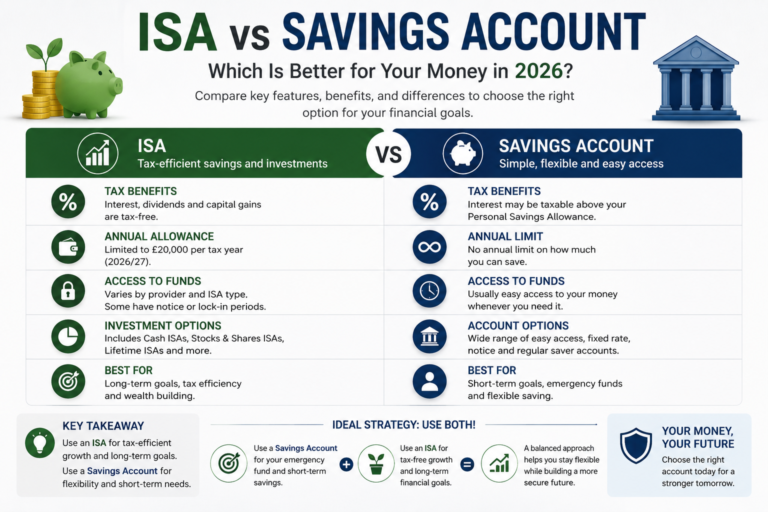
In the UK, your first £1,000 interest per year is tax-free if you’re a basic-rate taxpayer (or £500 if higher-rate). So a basic-rate saver with under ~£22,000 in an ordinary account probably pays no tax anyway. In that case, a standard savings account may do. But if you’re higher-rate or have lots of cash, use a Cash ISA: interest inside a Cash ISA is entirely tax-free. You can save up to £20,000 per year in ISAs.
Tip: If you pay tax on savings or your balances are large, max out your ISA allowance before saving elsewhere. (See our ISA vs Savings Account guide for details.) MoneySavingExpert explains, “Get 4.51% on up to £20k with a top cash ISA. A cash ISA is just a savings account where the interest isn’t ever taxable”.
What types of savings accounts exist?
Broadly, UK savings accounts fall into a few types:
- Easy-Access Accounts: Withdraw money anytime without penalty. Interest is usually variable. Good for emergency funds or if you may need the cash. (See “Best instant-access savers” below.)
- Fixed-Rate Accounts / Bonds: You lock your money for a set term (e.g. 1 to 5 years) and get a fixed rate. You cannot withdraw early without a penalty. If you won’t touch the cash, these often pay more. (See “Best fixed-rate accounts” below.)
- Notice Accounts: You must give notice (e.g. 30, 60 or 90 days) before withdrawing. Rates are usually between easy-access and fixed rates.
- Regular Savers: You commit to pay in a set amount each month (often £25–£300). The headline rate is high (5–8%), but it only applies as you build the balance. These help build a habit. (See “Best regular savers” below.)
- Cash ISAs: Like easy-access accounts but with tax-free interest up to £20k/year allowance. Rates are slightly lower than some non-ISA accounts, but the tax break can be valuable.
- Other Accounts: Some offer prizes (e.g. NS&I Premium Bonds) or special perks. There are also Young Saver accounts (for under-18s) often paying higher rates.
Each type has its uses: if you need liquidity, go easy-access or notice. If you have lumps to park, consider fixed-rate. Regular savers are great if you want to build savings steadily. For more on ISAs vs normal accounts, see our ISA vs Saving Account page.
What are the best easy-access savings accounts?
Many of the highest interest rates in 2026 are on easy-access accounts. These allow withdrawals anytime, no notice needed. You can get rates around 4.5–5.0% AER at top providers. For example:
- Santander Edge Saver: 6.00% AER up to £4,000 (12 months) – requires having a Santander Edge current account. After 12 months, the rate falls.
- Cahoot Sunny Day Saver: 5.00% AER up to £3,000 (12 months). After that, it moves to a standard account at 1%. (Note: you must apply via Cahoot’s website.)
- Revolut Instant Access: 5.00% AER up to £25,000 (through Dec 2026) – available to app users and new customers. T&Cs apply.
- Chase Boosted Saver: 4.50% AER up to £3m (first year) – requires opening a new Chase current account (via app).
- Marcus by Goldman Sachs: 3.75% AER – straightforward online savings (nationally available).
- Tembo HomeSaver: 4.55% AER – mobile app account with bonus conditions (see moneyfacts).
- Other accounts: Hargreaves Lansdown Active Savings (4.52% ISA*), Moneybox Cash ISA (4.0%), Chip Cash ISA (3.55%). (*Rates as of mid-2026.)
These are just examples; many challenger banks and fintech apps are in this space. Be aware of bonus expiries and eligibility (e.g. some require a bank current account with that provider). Always check the latest rates: they change frequently. Comparison sites like MoneySavingExpert and MoneySuperMarket update daily, so bookmark them.
What are the best fixed-rate savings accounts?
Fixed-rate bonds lock your cash for a term (often 1–5 years) in return for a guaranteed interest rate. Current deals (mid-2026) include:
- Habib Bank Zurich (UK) 1-Year e-Deposit: 4.91% AER – a top rate for a 12-month fix. Minimum deposit £1,000.
- NS&I 1-Year Fixed Rate Savings: 4.84% AER – backed by government, no FSCS limit issue. Must open online by ISA/ savings season.
- Raisin UK / Oakhill (Kuwait & Al Rayan): 4.75%–4.71% AER for 1-year or 2-year bonds. Manage via Raisin’s platform.
- Atom Bank 1-Year Fixed: ~4.80% AER (online bond).
- OakNorth Bank 12-Month Fixed: ~4.50% AER.
- Close Brothers 2-Year Fixed: ~4.70% AER.
- Kinnaird & Goodchild 3-Year Fixed: 4.50% AER (local society bond).
- Al Rayan Bank 1-Year Islamic Fixed: 4.70% AER (no Riba, up to £1m).
Longer-term fixes (3–5 years) pay slightly lower rates now because the Bank of England is expected to cut. The average 1-year fixed was ~4.2%, but these above beat the average. Fixed bonds suit cash you won’t need until maturity. If you cash out early, you’ll lose some interest.
What are the best regular saver accounts?
Regular savers reward you for building up savings with monthly deposits. Headline rates have reached 6–8% AER, though you can only pay in a limited amount each month (often £25–£300). Examples:
- Lloyds Monthly Saver: 8.00% AER (save £25–£250 per month) – available to Lloyds (or Halifax/Bank of Scotland) current account holders. (Halifax version doesn’t allow withdrawals.)
- Santander Regular Saver: 8.00% AER (save up to £200/month) – for Santander current account holders.
- First Direct Regular Saver: 7.00% AER (save £25–£300 per month) – for First Direct current account holders.
- Nationwide Flex Regular Saver: 6.50% AER (save up to £200/month) – linked to Nationwide FlexOne account.
- Club Lloyds Monthly Saver: 6.25% AER (£25–£400/month) – for Lloyds Club current account holders.
- NatWest / RBS Digital Reg Saver: 5.25% AER (up to £150/month).
Regular savers build discipline, but remember the effective return is lower since you add money gradually. (Martin Lewis notes that with a 6% regular saver, you earn only about half the implied interest on a full-year balance.) Still, it’s “free money” for saving. Set a standing order and forget it.
How do cash ISAs fit in?
A Cash ISA is a savings account with tax-free interest. You can save up to £20,000 each tax year across all ISAs. Typical rates on easy-access Cash ISAs are around 4.3–4.5% AER (a bit lower than top non-ISA rates), but every penny of interest is sheltered from tax.
For many savers (basic-rate) the £1,000 PSA covers interest on balances up to ~£22,000, so ISAs might not add much benefit for small savers. But if you pay higher-rate tax, or have over £20k, an ISA is vital. As Foundered explains, “If you are a higher-rate taxpayer or have more than £20,000 saved, maximising your ISA allowance should be a priority”. In short, use an ISA at least for part of your emergency fund or other savings to lock in tax-free growth. (See our ISA vs Savings Account page for more.)
How can I find and switch to the best rates?
The best deals change often. Banks launch and pull bonuses frequently, so a rate that’s top today may not be tomorrow. Keep an eye on comparison sites and financial news: MoneySavingExpert and MoneySuperMarket update daily, and Moneyfacts (cited in The Guardian) tracks hundreds of deals.
- Use comparison websites. MoneySavingExpert, MoneySuperMarket, or Money.co.uk show current best rates at a glance. Bookmark them and revisit every few weeks.
- Set alerts. Some sites (or apps) let you set alerts for new high rates. Or join newsletters (e.g. MSE’s weekly email) that announce rate changes.
- Be ready to switch. Competitive rates often require a new application. If your account has a bonus or higher rate for 12 months, mark the date to either reapply or move to another provider once it ends. Moving takes a few minutes online.
- Check eligibility. You may need to meet conditions (like being a new customer, or having a linked current account). Read the “Who can apply” criteria.
- Mind the fine print. Look at minimum/maximum deposits, withdrawal restrictions, and how interest is paid (monthly or yearly). Monthly interest is better for compounding.
Rachel Springall of Moneyfacts advises that proactivity pays off: “The choice [of high-rate accounts] is really good, but it’s all about being proactive and switching, and making the most of these products while they are there”. In other words, make it a habit to review your savings once or twice a year – you could earn hundreds more by simply moving your money.
FAQs: Common savings questions
Is saving still worth it?
Yes. With inflation over 3%, it’s better to save at 4–5% than keep cash in a zero-interest account. Even after tax (if any), you’re ahead. Using an ISA makes returns tax-free.
What is AER/Gross?
AER (Annual Equivalent Rate) shows the true yearly interest including compounding. Gross is simple interest before tax. We quote AER for easy comparison.
Why aren’t all banks offering 5%?
Only a few “challengers” and bonus accounts reach 5% in 2026. High street banks typically offer 1–2%. They rely on their size and may raise rates slowly. That’s why switching to a smaller provider can pay off.
Are there risks?
Aside from promotional conditions, the only real risk is forgetting to move money after a bonus ends. FSCS protects your cash up to £120k. To be safe, spread large sums across multiple banks if needed.
Should I use a savings app?
If you struggle to save, consider a savings app or “round-up” bot. They move small amounts from your current account into a savings pot automatically. Just ensure any app or platform you use is FCA-authorised and FSCS-backed.
Summary: Lock in high rates now
2026 offers some of the highest savings rates in decades. By choosing the right account type and staying alert, you can turn that spare cash into significant extra income each year. Aim for accounts with at least 4–5% interest, and remember FSCS protects your deposits. If you are comfortable with locking away funds, a fixed-term bond can guarantee returns ~4.5%. If you need flexibility, shop around for a top easy-access or regular saver account. And don’t forget to use ISAs or your PSA to avoid tax. As MoneySavingExpert reminds us, your savings deserve more than a sniff of 0.01% – “the same money in an easy access savings account at 4.5% earns £450” per £10k vs virtually nothing in a current account.
Stay proactive: compare rates on sites like Moneyfacts and MSE, and switch when a better deal appears. Good luck with rates this high, smart saving really pays!