Global Index Fund UK: How to Invest Globally and Grow Your Money
If you’re exploring long-term investing, a global index fund is often one of the first strategies recommended to UK investors looking for diversification, simplicity, and steady growth. A global index fund allows you to invest in companies across multiple countries and markets in a single investment, reducing risk while capturing global economic growth. Instead of…

If you’re exploring long-term investing, a global index fund is often one of the first strategies recommended to UK investors looking for diversification, simplicity, and steady growth. A global index fund allows you to invest in companies across multiple countries and markets in a single investment, reducing risk while capturing global economic growth.
Instead of trying to pick individual stocks or predict market trends, global index funds track major indices that represent global markets. This approach is widely used by beginners and experienced investors alike because it focuses on long-term consistency rather than short-term speculation.
In this guide, we’ll explain what a global index fund is, how it works in the UK, its advantages and risks, and how you can start investing responsibly.
Quick answer: which global index fund should you choose?
Quick answer: A global index fund tracks a world stock market index, so one fund spreads your money across thousands of companies in many countries at once. There is no single best global index fund, but the cheapest well known options for UK investors currently charge between 0.12% and 0.23% a year: Fidelity Index World Fund at 0.12%, HSBC FTSE All-World Index Fund at 0.13%, iShares Core MSCI World ETF at 0.20% and Vanguard FTSE Global All Cap Index Fund at 0.23%, checked on 3 October 2026. The right pick depends on the index you want covered and on platform fees, which sit on top of the fund charge.
What Is a Global Index Fund?
A global index fund is a type of investment fund that tracks a broad international stock market index. Instead of actively selecting stocks, the fund automatically invests in a wide range of companies based on a predefined index.
For example, many index funds track indices like:
These indices include companies from multiple countries, sectors, and industries.
How Global Index Fund Work
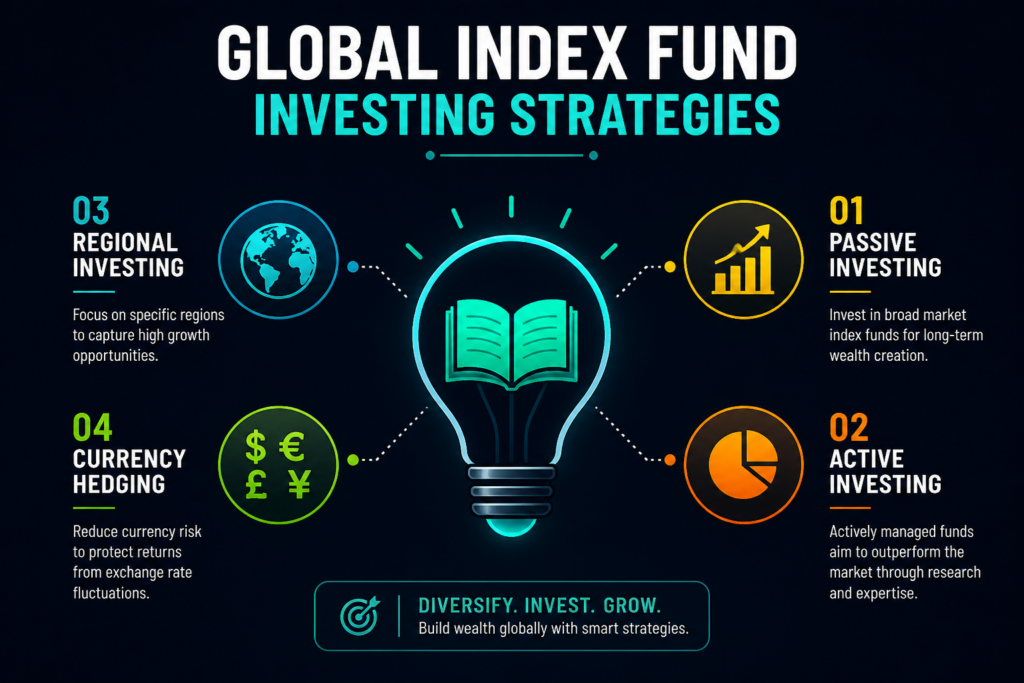
Global index funds are passively managed, meaning they follow a set index rather than trying to outperform it.
Here’s how they operate:
- The fund selects an index to track
- It invests in the same companies within that index
- It adjusts holdings automatically as the index changes
- Investors receive returns based on overall market performance
This structure keeps costs lower compared to actively managed funds.

Why UK Investors Choose Global Index Fund
For UK investors, diversification is key. Investing only in UK companies exposes you to local economic risks.
A index fund spreads your investment across:
- The United States
- Europe
- Asia-Pacific
- Emerging markets
This reduces reliance on a single economy.
Benefits of Investing in a Global Index Fund
1. Diversification Across Markets
Instead of investing in one country, your money is spread globally. This reduces risk if one region underperforms.
2. Lower Costs
Passive funds have lower fees because they don’t require active management. Over time, lower fees can significantly improve returns.
3. Simplicity
You don’t need to research individual stocks. One fund provides exposure to hundreds or even thousands of companies.
4. Long-Term Growth Potential
Global markets tend to grow over time. A global index fund allows you to benefit from this growth.
5. Reduced Emotional Investing
Because you’re tracking the market, there’s less temptation to make impulsive decisions based on short-term news.
Risks of Global Index Funds
No investment is risk-free. It’s important to understand the downsides.
Market Risk
If global markets fall, your investment will also decline.
Currency Risk
Returns may be affected by exchange rate fluctuations.
No Outperformance
You won’t beat the market, you’ll match it.
Economic Exposure
Global events can impact multiple markets simultaneously.
Global Index Fund vs UK Index Fund
| Feature | Global Index Fund | UK Index Fund |
|---|---|---|
| Diversification | High | Low |
| Risk | Spread across countries | UK-focused risk |
| Growth potential | Broader | Limited to UK economy |
For most UK investors, global funds offer better diversification. If you want to see the UK-only route in detail, our guide to the FTSE 100 index explains what a UK tracker holds and how concentrated it is.
Popular Global Index Fund Options for UK Investors
Some widely used funds include:
- Vanguard FTSE Global All Cap Index Fund
- iShares Core MSCI World ETF
- HSBC FTSE All-World Index Fund
- Fidelity Index World Fund
These funds differ in coverage, fees and structure, so it’s important to compare before investing.
Cheapest Global Index Funds Compared
The table below compares the ongoing charge of the four funds above. Every figure was checked against the provider’s own factsheet or costs disclosure on 3 October 2026. Charges can change, so confirm the figure on the provider’s website before you invest.
| Fund | Index it tracks | Ongoing charge | Where you can buy it |
|---|---|---|---|
| Fidelity Index World Fund P Acc | MSCI World | 0.12% a year | Fidelity and most major platforms |
| HSBC FTSE All-World Index Fund C Acc | FTSE All-World | 0.13% a year | Most major platforms, including Hargreaves Lansdown and AJ Bell |
| iShares Core MSCI World UCITS ETF (SWDA) | MSCI World | 0.20% a year | London Stock Exchange, through platforms and brokers |
| Vanguard FTSE Global All Cap Index Fund GBP Acc | FTSE Global All Cap | 0.23% a year | Vanguard Investor UK and most major platforms |
Two things explain most of the gap between these charges. The first is coverage. MSCI World holds large and mid sized companies from developed markets only. FTSE All-World adds emerging markets such as China and India, and FTSE Global All Cap adds smaller companies on top of that, so the broader funds cost a little more to run. The second is that the fund charge is not your only cost. Your platform adds its own fee, and an ETF has to be bought through a broker, so platform and dealing costs can outweigh a few hundredths of a percent of fund charge. Compare the total cost on your chosen platform, not just the fund fee.
How to Invest in a Global Index Fund in the UK
Step 1: Choose an Investment Platform
Popular UK platforms include:
- Hargreaves Lansdown
- AJ Bell
- Fidelity International
Platform charges vary widely and they sit on top of the fund charge, so the platform decision matters. Our guide to the best trading platforms in the UK compares what the main platforms cost and what each one offers.
Step 2: Open an Account
You can invest through:
- Stocks & Shares ISA
- General investment account
- Pension (SIPP)
Step 3: Select Your Fund
Choose a global index fund based on:
- Fees
- Coverage
- Fund size
- Performance history
Step 4: Invest Regularly
Monthly investing (pound-cost averaging) helps reduce risk over time.
Global Index Funds and ISAs
In the UK, using a Stocks & Shares ISA allows you to invest tax-efficiently.
Benefits include:
- No capital gains tax
- No tax on dividends
- Long-term compounding advantages
This makes ISAs one of the best ways to invest in global index funds.
Long-Term Strategy: Why Patience Wins
A investing works best over long periods.
Short-term market movements are unpredictable. But historically, global markets have shown upward trends over decades.
Key principles:
- Stay invested
- Avoid panic selling
- Reinvest dividends
- Focus on long-term goals
Common Mistakes to Avoid
Trying to Time the Market
Most investors fail to predict market highs and lows.
Overtrading
Frequent buying and selling increases costs.
Ignoring Fees
Even small fees reduce long-term returns.
Lack of Diversification
Avoid concentrating too much in one region.
E-E-A-T & Responsible Investing
This guide on global index funds is based on widely accepted investing principles and is intended for educational purposes only.
Investing always carries risk, and the value of investments can go down as well as up. Past performance is not a reliable indicator of future results.
UK investors should consider their individual financial situation and may benefit from speaking with a qualified financial adviser regulated by the Financial Conduct Authority before making investment decisions.
Final Thoughts
A index fund offers one of the simplest and most effective ways for UK investors to build long-term wealth. By spreading investments across global markets, reducing costs, and focusing on steady growth, these funds align well with disciplined investing strategies.
For beginners, they provide an easy entry into investing. For experienced investors, they remain a core portfolio component.
The key is consistency, patience, and understanding how markets work over time.
Frequently Asked Questions (FAQ)
What is a global index fund?
A global index fund is an investment fund that tracks a global stock market index, providing exposure to companies across multiple countries.
Are global index funds good for UK investors?
Yes, they offer diversification, lower risk compared to single-country funds, and long-term growth potential.
How do I invest in a global index fund in the UK?
You can invest through platforms like Hargreaves Lansdown or AJ Bell using an ISA or investment account.
Is a global index fund safe?
They are considered lower risk than individual stocks but still subject to market fluctuations.
What is the best global index fund?
Popular options include Vanguard FTSE Global All Cap Index Fund and iShares Core MSCI World ETF, depending on your goals. The cheapest options are compared in the table above, with ongoing charges starting at 0.12% a year.
Should I invest in a global index fund or just the S&P 500?
The S&P 500 covers US companies only, roughly 500 of the largest. A global fund still holds the US as its biggest part, but adds Europe, Japan, the UK and, in all-world funds, emerging markets as well. Choose the S&P 500 if you specifically want US exposure. Choose a global fund if you want one holding that does not depend on a single country’s market.
What is the difference between FTSE All-World and MSCI World?
Both are global indices, but they draw the map differently. MSCI World covers large and mid sized companies in developed markets only, around 1,300 companies. FTSE All-World covers developed and emerging markets, more than 3,500 companies, so it includes countries such as China, India and Brazil. In practice the two usually perform closely, because US companies dominate both indices.
Should I choose accumulation or income units?
Accumulation units reinvest any dividends inside the fund, so your money compounds without you doing anything. Income units pay the dividends out as cash, which suits investors who want to draw an income. Most long-term investors saving inside an ISA or SIPP choose accumulation for simplicity. The underlying fund is the same either way; only the treatment of dividends differs.
Which is the cheapest global index fund in the UK?
On fund charge alone, Fidelity Index World Fund at 0.12% a year and HSBC FTSE All-World Index Fund at 0.13% a year are the cheapest funds in our comparison, checked on 3 October 2026. They track different indices, and your platform fee sits on top of either charge. The cheapest overall package depends on where you hold the fund, so compare the fund charge and the platform charge together.
Is one global index fund enough for a whole portfolio?
For the shares part of a portfolio, it can be. One global fund already holds thousands of companies across countries and sectors. What it does not hold is bonds, property or cash, so its value will rise and fall with the stock market as a whole. Investors who want a smoother ride often pair it with a bond fund or cash savings, depending on their goals and time horizon.
Last updated: October 2026. Fund charges in this guide were checked against provider factsheets and costs disclosures on 3 October 2026.
Got a UK money question?
Ask it in the Ask UKMT live chat. No sign up, no names, and the answers are checked against official sources. Open the live chat