
Mortgage Overpayment Calculator
Checked 10 November 2026. Bank Rate: 4%. Rates from Moneyfacts, 9 November 2026.
The short answer
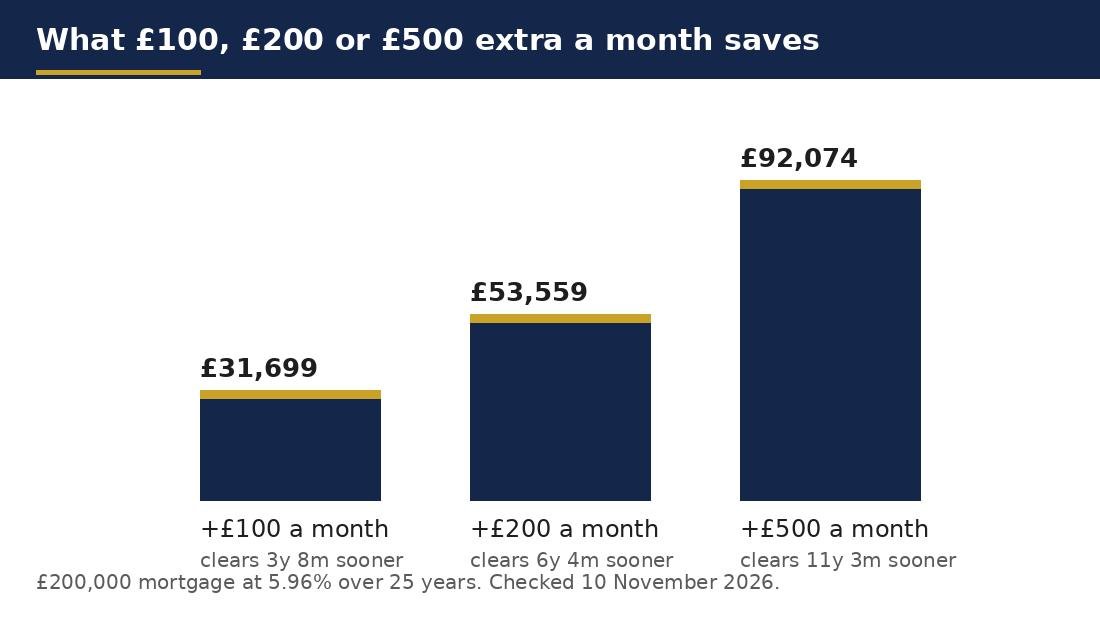
Overpaying your mortgage cuts the interest you pay and clears the debt sooner, because every extra pound goes straight to reducing the amount you owe. On a £200,000 mortgage at 5.96% over 25 years, paying an extra £200 a month saves £53,559 in interest and clears the mortgage in 18 years and 8 months, which is 6 years and 4 months sooner. Most UK lenders let you overpay up to 10% of the balance each year without a charge, but the exact rule differs by lender, so check yours first.
Work out your savings
Enter your figures and press Calculate. This mortgage early repayment calculator shortens your term, which saves the most interest. It assumes your rate stays the same for the whole term.
Example: £200,000 at 5.96% over 25 years, plus £200 a month. Your normal monthly payment is £1,283.72. Without overpaying, you would pay £185,115 in interest. With the overpayment, you would clear the mortgage in 18 years and 8 months, saving £53,559 in interest.
What it means for your money
Interest is charged on the balance, so a smaller balance means less interest every month after that. The earlier you overpay, the more years of interest you avoid. A small monthly habit beats a large lump sum left for later, because the money has more years to work. The one thing to check first is the early repayment charge, because a charge can wipe out months of saving in a single payment.
How much could overpaying save you?
These are worked examples on a £200,000 mortgage over 25 years, with the rate held the same for the whole term. A two-year fix does not hold its rate for 25 years, so treat the totals as a guide, not a promise. If you do not know your normal payment, work it out first with our Mortgage Calculator.
| Rate | Normal monthly payment | Total interest with no overpayment | Extra £200 a month saves | Mortgage cleared in |
|---|---|---|---|---|
| 4.5% | £1,111.66 | £133,499 | £36,280 | 18 years and 11 months |
| 4.90% (best 2-year fix, Yorkshire Building Society) | £1,157.56 | £147,267 | £40,702 | 18 years and 10 months |
| 5.96% (average 2-year fix) | £1,283.72 | £185,115 | £53,559 | 18 years and 8 months |
Smaller amounts help too. On the same £200,000 mortgage at 4.5%, an extra £100 a month saves £21,142 and clears it 3 years and 6 months sooner, and an extra £500 a month saves £63,887 and clears it 11 years sooner. See the latest best buys on our Mortgage Rates Today page.
A lump sum works the same way. A £10,000 lump sum on a £250,000 mortgage at 4.5% over 25 years saves £19,584 and cuts 1 year and 9 months off the term when used to shorten the term.
How much can I overpay without a charge?
Most UK lenders let you overpay up to 10% of the balance each year without an early repayment charge, but they do not all measure that 10% the same way, and the difference can cost thousands of pounds.
| Lender | How the allowance is measured |
|---|---|
| Nationwide | 10% of the original loan amount, not the balance |
| Halifax | 10% of the amount owed on 1 January |
| NatWest | 20% of the balance each year |
| Santander | 10% of a fixed rate loan each calendar year, no carry over |
| Barclays | No single published figure; check your mortgage offer |
| Tracker or standard variable rate | Normally no charge at all, so overpayments are usually unlimited |
Unused allowance does not roll over to the next year. Nationwide also allows unlimited overpayments in the final month of a deal, which is the cheapest time to pay a large lump sum. Always check your own mortgage offer, because your deal may differ from the standard rule.
What does an early repayment charge cost?
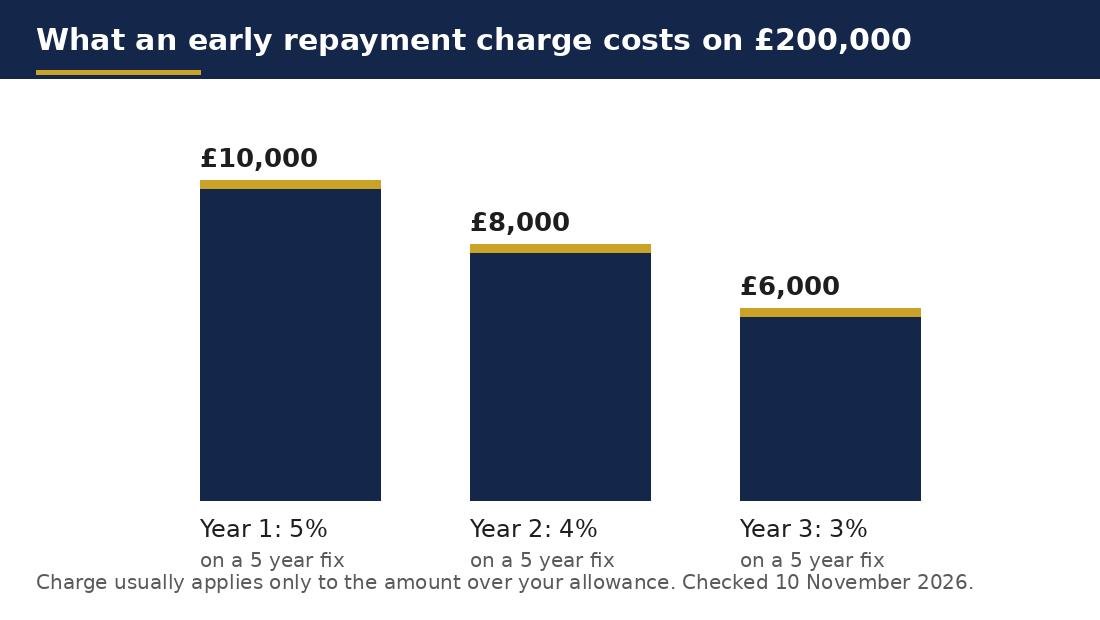
An early repayment charge is a fee your lender charges when you repay more than your allowance during a fixed deal. It is usually between 1% and 5% of the amount you repay over the allowance, and it often steps down over the deal, for example 5% in year one, 4% in year two and 3% in year three of a five-year fix. On a £200,000 balance, that is £10,000 in year one, £8,000 in year two and £6,000 in year three.
Halifax gives a clear worked example. If you owe £50,000 on 1 January, your allowance is £5,000. If you overpay by £8,000, the £3,000 above the allowance is charged at 5%, which is £150. The charge applies only to the amount over the allowance, not to the whole overpayment. Before making any large lump sum payment, ask your lender for the exact charge in pounds, and compare it with the interest you would save.
Is a lump sum or a monthly overpayment better?
Paying money early beats paying the same amount later, because it has more years to stop interest from building up. A lump sum paid in year three removes a large chunk of interest straight away. A monthly habit is easier to keep up, and it does not need cash lying around. If you have both, do both. The timing rule matters more than the format: pay it as early as you can, and keep the habit going.
Should I shorten the term or lower my monthly payment?
After a large lump sum, some lenders recalculate your monthly payment from the lower balance, so the term stays the same and your bill falls. If your fix is ending soon, read how long to fix your mortgage for before you decide. The other choice is to keep the payment the same and shorten the term, which saves far more interest. On a £250,000 mortgage at 4.5% over 25 years, a £10,000 lump sum used to shorten the term saves £19,584, but the same £10,000 used to lower the payment saves only £6,675, with the payment falling from £1,389.58 to £1,334.00 a month. Tell your lender which one you want, because the default is not always the one that saves you the most.
Should I overpay my mortgage or invest the money?
Overpaying gives you a guaranteed return equal to your mortgage rate. If your rate is 5.96%, every pound overpaid saves you 5.96% a year in interest, with no risk. Investing might earn more, but the return is not guaranteed. The best easy access cash ISA pays 5.02% (Trading 212, checked 9 November 2026), which is below the average mortgage rate, so overpaying wins on the numbers for most borrowers on a fix above 5%.
There is no tax point in favour of overpaying for homeowners. The UK has no mortgage interest tax relief for owner-occupiers, because Mortgage Interest Relief at Source ended on 6 April 2000. Do not let anyone tell you that keeping the mortgage saves you tax. Keep cash you might need somewhere you can reach it, because money paid into a mortgage is hard to get back.
When is overpaying the wrong move?
Clear dearer debt first. Paying off a mortgage at 5% while carrying credit card debt at 25% or more is the wrong order, because the card costs you far more. If you are weighing a loan against overpaying, work out the loan cost with our Personal Loan Calculator. Keep an emergency fund of three to six months of spending before you overpay, because a broken boiler paid for on a credit card can wipe out your savings. And if the early repayment charge is bigger than the interest you would save, wait until the deal ends and pay the lump sum then.
How to overpay, step by step
Step 1: call your lender and ask for your allowance, your early repayment charge, and how extra money is applied. Ask for it to reduce the capital, and get it in writing if you can. Step 2: set up a monthly overpayment by standing order or bank transfer, separate from your normal payment, so it is not absorbed into the next payment. Step 3: check your next statement and make sure the balance fell by the amount you paid. Step 4: repeat the check once a year, and rerun the numbers when your deal ends or rates move. A lower balance can also move you into a cheaper loan-to-value band when you remortgage.
Frequently asked questions
How much can I overpay on my mortgage without a charge?
Most UK lenders allow 10% of the balance each year without a charge, but the measure differs. Nationwide uses 10% of the original loan amount, Halifax uses 10% of the amount owed on 1 January, and NatWest allows 20%. Tracker and standard variable rate mortgages normally have no charge. Check your mortgage offer for your exact figure.
How much should I overpay on my mortgage each month?
Pay what you can afford every month without touching your emergency fund. On a £200,000 mortgage at 5.96% over 25 years, £100 a month extra saves £31,699 in interest, £200 saves £53,559, and £500 saves £92,074. Start with £50 this month rather than waiting to start with £500 next year, because early money saves more.
Does overpaying reduce my monthly mortgage payment?
Only if you ask your lender to recalculate it, or if they do it automatically after a lump sum. By default, most lenders keep your payment the same and shorten the term, which saves the most interest. If you want a lower bill instead, tell your lender, and check the savings, because it is much smaller.
Can I get my overpayments back?
Not easily. Once the money is paid into the mortgage, it becomes equity in your home. You can only access it by selling, remortgaging, or borrowing against the home, and some lenders offer a drawdown or reserve facility that lets you borrow back overpayments. Check whether yours does before you pay in money you might need.
Does overpaying improve my credit score?
Only indirectly. Overpaying lowers the balance you owe, which can help when a lender looks at your application for new credit, but it does not add points to your score by itself. Paying on time every month matters far more for your score than overpaying does.
How to pay off your mortgage early with a calculator?
This mortgage early repayment calculator works like this: enter your balance, your interest rate, and your remaining term, then add a monthly overpayment or a lump sum. The calculator shows your normal payment, the interest you would pay without overpaying, and the interest and time you save. Try £100, £200 and £500 a month to see how the saving grows.
How much overpayment on a mortgage is worth it?
Any overpayment is worth it if it is within your free allowance and you have an emergency fund first. The savings grow with the amount and with how early you pay it. Compare the interest saved with the early repayment charge, if one applies. If the charge is bigger than the saving, wait until your deal ends.
Should I overpay my mortgage or save the money?
Overpaying is the better return when your mortgage rate is higher than the savings rate you can get. The average two-year fix is 5.96%, and the best easy-access cash ISA is 5.02%, so overpaying wins for most borrowers on a fix. Keep three to six months of spending in savings first, then overpay with the rest.
Sources
- Bank of England, Monetary Policy Report, November 2026 (Bank Rate 4%, 5 November 2026)
- Moneyfactscompare, fixed rate mortgages (best 2-year fix 4.90%, best 5-year fix 4.94%, averages 5.96% and 5.99%, 9 November 2026)
- Nationwide, overpayments (10% of the original loan amount; tracker mortgages have no early repayment charges)
- Halifax, early repayment charges (10% of the amount owed on 1 January, worked example £150 on a £3,000 excess at 5%)
- HomeOwners Alliance, early repayment charges (typically 1% to 5%, updated 13 October 2026)
Your home may be repossessed if you do not keep up repayments on your mortgage. This page is general guidance, not financial advice. Rates and lender rules change, so check your own mortgage offer before you overpay.