
Retirement Planning UK: The Complete 2026 Guide
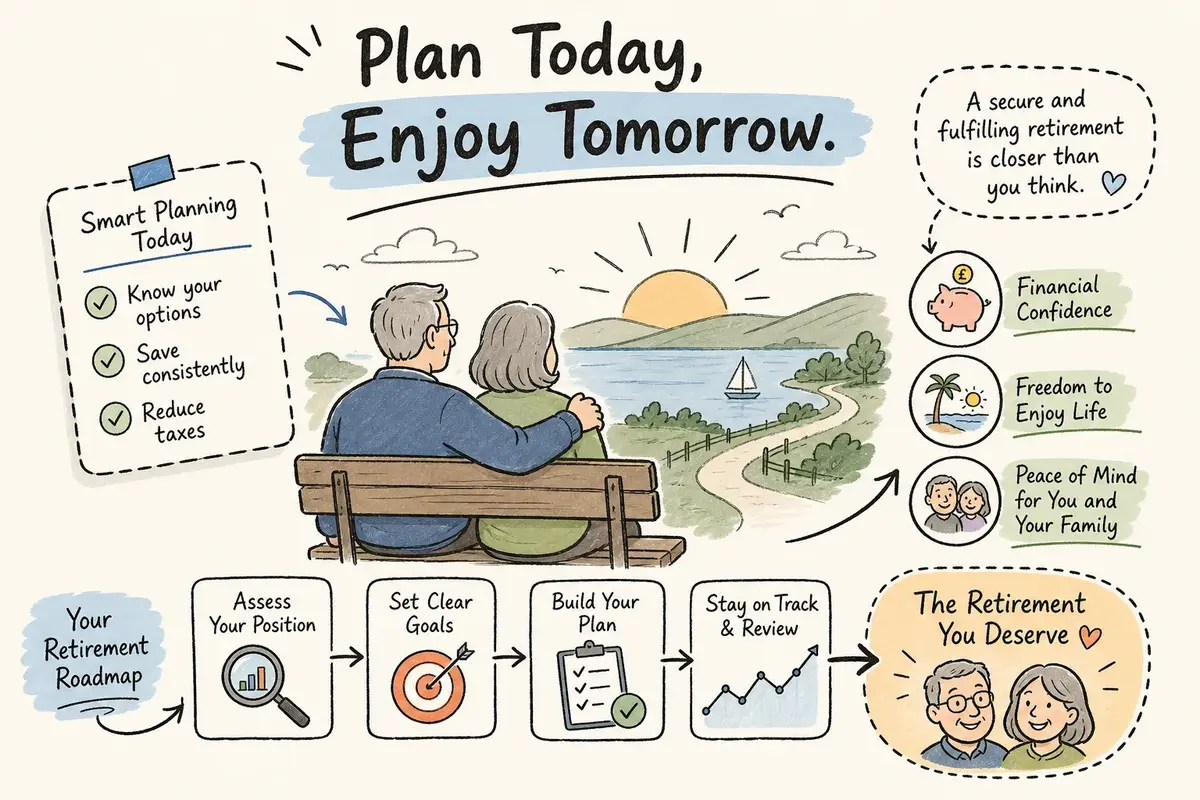
Many people across the UK are aware they should be taking retirement planning seriously, but don’t know where to begin or whether what they’re already doing is anywhere near enough. Effective retirement planning UK-wide starts with a single, honest look at the numbers, and that gap between “meaning to sort it” and actually having a plan is where years of potential compound growth quietly disappear. At UK Markets Today, we cover these topics in plain English every day, because the decisions you make now about pensions and savings have a direct bearing on the quality of life you’ll have in retirement. By the end of this guide, you’ll know your projected retirement income, whether you have a shortfall and exactly what actions to take next.
Thank you for reading this post, don't forget to subscribe!Retirement planning in the UK involves several moving parts: the State Pension, workplace schemes, private pensions, and tax-efficient savings wrappers like ISAs and SIPPs. None of these are especially complicated on their own, but most people have never sat down and added them together. That’s what this guide is for.
Retirement Planning UK: what retirement actually costs in 2026
The three living standards and their annual price tags
The Pensions and Lifetime Savings Association (PLSA) publishes its Retirement Living Standards each year, giving concrete income targets for a single person based on three quality-of-life levels. For 2026, those figures are £13,900 per year at the minimum standard, £32,700 at moderate, and £45,400 at comfortable. These are after-tax figures, calculated by Loughborough University’s Centre for Research in Social Policy, and they reflect actual spending patterns rather than abstract estimates.
At the minimum standard, you can cover all basic needs and afford the occasional treat, but there’s no car, no overseas holiday, and eating out is a once-a-month event. The moderate standard brings a car, annual holidays abroad, and noticeably more financial breathing room. At the comfortable level, you’re enjoying domestic breaks more frequently, eating out regularly, and have genuine financial flexibility for the unexpected. Decide which level you’re aiming for before building your income plan; without a target, you can’t measure a shortfall.
Why the State Pension alone won’t cover most people’s expectations
The full new State Pension for 2026/27 is £241.30 per week, which works out to £12,547.60 per year. That figure falls short of even the minimum single-person PLSA standard of £13,900, let alone the moderate target of £32,700 or the comfortable level of £45,400. The gap between £12,547 and £32,700 is not a small rounding error; it’s over £20,000 of annual income that has to come from somewhere else.
This is the core motivation for everything that follows. The State Pension alone is unlikely to meet moderate or comfortable PLSA targets for most individuals, making workplace and private pensions a fundamental part of any serious retirement income strategy, not optional extras.
Your State Pension: the foundation of retirement income planning
How qualifying years determine what you’ll receive
Your State Pension is built on your National Insurance (NI) record, not your salary or the direct contributions you make. You need 35 qualifying years to receive the full £241.30 per week. Fewer than 35 years gives you a proportionally smaller amount, and fewer than 10 years means you receive nothing at all. As a working example: 20 qualifying years gives you 20/35 × £241.30 = £137.88 per week, or roughly £7,170 per year.
The current State Pension age is 66. It rises to 67 for those born on or after 6 April 1960. A further rise to 68 is expected for those born after April 1977, phased in between 2044 and 2046, a timetable that has been subject to political debate and may yet shift. The 4.8% increase applied from April 2026 was driven by the government’s triple lock policy, which uprates the pension each year by the highest of earnings growth, inflation, or 2.5% (benefit and pension rates 2025 to 2026).
How to get your personal State Pension forecast
The most reliable first step in any UK retirement plan is to get your personal State Pension forecast from the gov.uk Future Pension Centre. The tool shows your current NI record, your projected State Pension amount, and whether you have gaps that can be filled through voluntary contributions. According to gov.uk guidance, Class 3 voluntary NI contributions cost around £907.40 per year for a standard gap, and a single missing year can add up to £328.64 to your annual pension, making the maths worth checking carefully.
This forecast is free, takes minutes to access, and gives you a real figure rather than a guess. Run this first, before doing anything else, because everything else in your retirement income calculation depends on it.
Adding up your pension pots to project total retirement income
Once you have your State Pension figure, the next step is building a picture of your workplace and private pension savings, because these two income sources, combined, form the foundation of your retirement plan.
Understanding how defined contribution pensions convert to income in retirement planning uk
The majority of workplace and private pensions operating today are defined contribution (DC) schemes. What you get at retirement depends on how much has been paid in, any employer top-ups, and investment growth over time. Under auto-enrolment rules, the minimum total contribution is 8% of qualifying earnings, split between 5% from you and 3% from your employer, on earnings between £6,240 and £50,270 (what you, your employer and the government pay).
To convert a pot into annual income, financial planners commonly cite a 4, 5% annual withdrawal rate as a working starting point. A £200,000 pot at that rate produces £8,000, £10,000 per year before tax. It’s worth noting that 75% of withdrawals beyond the 25% tax-free portion are taxed as income, so the net figure you receive will depend on your total income in retirement and where you sit in the income tax bands.
The best calculators to estimate your combined retirement planning uk income
To build a complete picture, use three sources together: the gov.uk State Pension forecast tool for your state pension figure; the MoneyHelper pension calculator for overall projections combining contributions, growth, and retirement age; and provider-specific tools from Standard Life pension calculator or Vanguard pension calculator for pot-based income modelling. You can also try our UK financial calculators for a quick cross-check alongside provider tools. The government tools are free to use, and major provider calculators are generally available without requiring you to be an existing customer, though terms can vary by provider.
When running these calculations, use figures in today’s money terms rather than inflated projections. A projected pot of £350,000 in 20 years sounds significant, but its real purchasing power will be lower. Planning in real terms keeps your targets grounded and avoids an unpleasant surprise when you actually reach retirement age.

Tax-efficient savings vehicles to close any retirement planning uk shortfall
SIPPs: boosting your pension with tax relief
A Self-Invested Personal Pension (SIPP) lets you contribute up to your full annual earnings or £60,000, whichever is lower, per tax year, and claim income tax relief at your marginal rate. For a basic-rate taxpayer, an £800 contribution becomes £1,000 in the pension once 20% relief is added. For higher-rate taxpayers, the effective cost of £1,000 going into the pension is just £600, making SIPPs particularly powerful for anyone in the 40% band.
SIPPs are especially well suited to self-employed individuals, anyone whose employer scheme offers limited investment options, or people who want to carry forward unused allowances from the previous three tax years. Carry forward can enable total contributions of up to £240,000 in a single tax year if allowances from prior years are available and unused.
ISAs as a complementary retirement savings tool
A Stocks and Shares ISA allows up to £20,000 per tax year to grow completely free of capital gains tax and income tax, and withdrawals don’t count as taxable income. That last point matters in retirement: ISA withdrawals won’t push you over the basic-rate threshold or reduce any means-tested benefits, unlike pension income. Used alongside a pension, an ISA gives you a tax-efficient income stream you can control separately.
One development worth tracking: from April 2027, the Cash ISA allowance for under-65s is set to drop to £12,000 while the Stocks and Shares ISA limit stays at £20,000. This makes 2026/27 the final year where the full £20,000 Cash ISA allowance applies regardless of age. UK Markets Today covers policy changes like this as they’re confirmed, so you can adjust your savings priorities in real time rather than finding out after the deadline has passed.
How to take your pension: withdrawal options and their tax impact
Flexi-access drawdown: flexibility with responsibility
With flexi-access drawdown, your pension pot stays invested and you withdraw as much or as little as you need. Up to 25% of the pot can be taken tax-free (the Lifetime Allowance was abolished from April 2024, but a tax-free lump sum limit of £268,275 remains in place for 2026/27 under current HMRC rules, check gov.uk for transitional protections that may apply to your circumstances). Everything beyond that 25% is taxed as income at your marginal rate when you take it. The flexibility is genuine: there is no minimum income requirement, and you can take withdrawals monthly, annually, or in one-off chunks.
The important caveat is the Money Purchase Annual Allowance (MPAA). The moment you take your first taxable withdrawal, the MPAA kicks in, reducing your future annual pension contributions to £10,000. If you intend to keep working and contributing to a pension after starting drawdown, time your first taxable withdrawal carefully. Taking only the tax-free lump sum does not trigger the MPAA.
Annuities and lump sums: when a guaranteed income makes sense
An annuity exchanges your pension pot for a guaranteed income for life or a fixed term. The same 25% tax-free rule applies before you purchase, and the annuity income itself is taxed as regular income. The appeal is straightforward: you eliminate longevity risk entirely, because the income continues regardless of how long you live. The drawback is that once the annuity is purchased, there is no flexibility; you can’t access the capital if your circumstances change.
Taking the entire pot as a single lump sum is also an option, but it requires careful thought. A large one-off withdrawal can push you from the basic rate into the higher rate tax band for that tax year, effectively handing a significant portion to HMRC unnecessarily. Staging withdrawals across multiple tax years is often more efficient. For anyone approaching retirement age, taking regulated financial advice before committing to any of these options is time and money well spent.
Retirement Planning UK: your six-step checklist for 2026
Steps 1 to 3: building your baseline picture
Step 1: Get your State Pension forecast. Use the gov.uk Future Pension Centre tool. Check your NI record for gaps and calculate whether voluntary contributions would increase your pension by more than they cost. For more on how the State Pension works and eligibility, see our guide to the State Pension UK 2026.
Step 2: Locate all your pension pots. If you’ve had multiple employers, you may have old workplace pensions sitting dormant. Use the government’s Pension Tracing Service to track them down, then request current valuations from each provider.
Step 3: Run the numbers through a pension calculator. Use MoneyHelper or a provider tool to combine your State Pension and pot projections into a single annual retirement income figure. If you want to try a quick in-house tool, use our Pension Calculator UK to estimate your likely retirement income and test different contribution scenarios.
Steps 4 to 6: closing the gap and protecting your plan
Step 4: Compare your projected income to your target living standard. Put the PLSA figures alongside your projection. If your combined income falls short of your target standard, quantify that gap in annual terms, because that’s what you’re working to close.
Step 5: Boost contributions through your workplace scheme, SIPP, or ISA. Even modest increases made 10 to 15 years before retirement compound significantly over time. An extra £100 per month into a pension for 15 years at 5% annual growth adds over £26,000 to your pot.
Step 6: Review annually. Set a recurring date each year to revisit your plan. Contribution limits, tax rules, and your own circumstances all shift, and a plan that was right two years ago may need updating today.
The next step is simpler than you think
Retirement planning UK-wide doesn’t need to be complicated, but it does need to be deliberate. The full picture comes from combining your State Pension forecast, your pension pot projections, and any ISA or other savings, then comparing that total against the income you actually want in retirement. The earlier you do this, the more options you have to close any gap through contributions, NI top-ups, or tax-efficient savings vehicles.
Government policy around pensions and ISAs shifts regularly. The triple lock, contribution limits, State Pension age, and ISA rules have all changed in recent years and will continue to evolve. Staying informed isn’t optional if you want your plan to remain effective. UK Markets Today publishes daily updates on pension policy, savings rates, and government guidance in plain English, so you can act on changes as they happen rather than catching up after the fact.
Start your retirement planning UK review this week with step one: get your State Pension forecast from gov.uk. It takes less than ten minutes, costs nothing, and gives you the most important number in your retirement plan. Everything else builds from there.
FAQ
How much do I need to retire in the UK in 2026?
The Pensions and Lifetime Savings Association (PLSA) Retirement Living Standards for 2026 give after-tax targets of £13,900 a year for a minimum standard, £32,700 for a moderate standard, and £45,400 for a comfortable standard. These figures are calculated by Loughborough University’s Centre for Research in Social Policy and reflect actual spending patterns, so decide which level you want before planning your income.
Will the State Pension cover my retirement needs?
The full new State Pension for 2026/27 is £241.30 per week (about £12,547.60 a year), which falls short of the PLSA minimum standard and is far below moderate or comfortable levels. That means most people will need workplace and private pensions or other savings to fill a substantial income gap.
How is the State Pension amount calculated?
Your State Pension depends on your National Insurance (NI) record rather than salary; you need 35 qualifying years to get the full £241.30 per week. Fewer years give a proportionally smaller pension (for example, 20 qualifying years gives about £137.88 per week, roughly £7,170 a year), and fewer than 10 qualifying years means no entitlement.
What is the State Pension age in the UK?
The current State Pension age is 66. It rises to 67 for those born on or after 6 April 1960, and a further rise to 68 is expected for people born after April 1977, phased between 2044 and 2046, although that timetable remains politically debated.
Why did the State Pension increase in April 2026 and by how much?
A 4.8% increase applied from April 2026 driven by the government’s triple lock policy, which uprates the pension each year by the highest of earnings growth, inflation, or 2.5%. That mechanism determines annual uprating rather than ad-hoc decisions.
What sources should I add together when calculating my retirement income?
Include your State Pension, workplace pension schemes, private pensions and tax-efficient savings wrappers such as ISAs and SIPPs. The guide emphasises that none are complicated alone, but many people have never sat down and added them together to see their true projected income.
How do I know if I have a retirement shortfall and what should I do next?
Start with an honest projection of your retirement income and compare it to the PLSA target level you want; if your total falls short, you have a shortfall that needs addressing. The article recommends acting now, boosting pension contributions, using workplace schemes or increasing tax-efficient saving in ISAs or SIPPs, because delays can lose years of compound growth.