FTSE 100 Today: Oil Prices Rise as BP and Shell Lead UK Markets
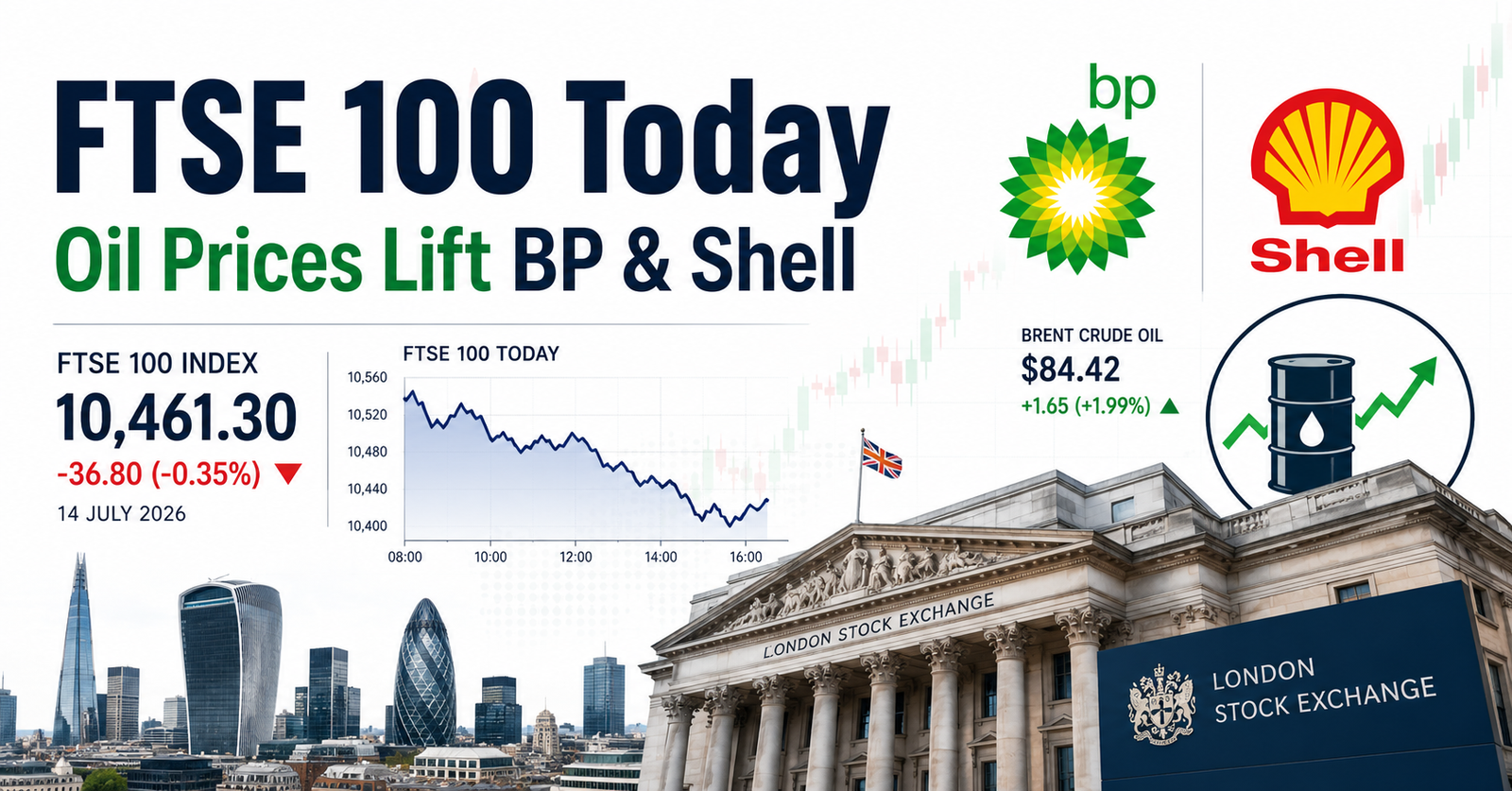
FTSE 100 Today traded lower on Tuesday as investors reacted to rising oil prices, renewed geopolitical tensions and mixed global market sentiment. Energy heavyweights BP and Shell outperformed the broader market, helping to limit losses in the UK’s benchmark index. This market update covers today’s FTSE 100 performance, the biggest market movers, the reasons behind the index’s decline and what investors should watch in the next trading session.
Thank you for reading this post, don't forget to subscribe!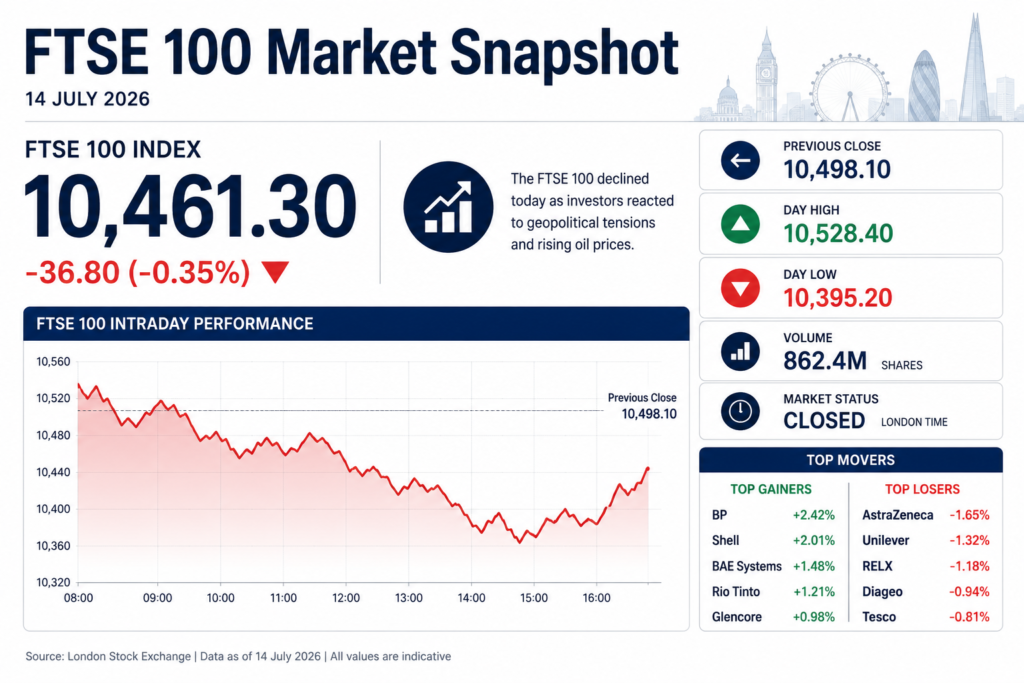
Quick Summary
The FTSE 100 traded lower during Tuesday’s session as investors balanced stronger energy stocks against wider market caution. Rising crude oil prices supported heavyweight companies including BP and Shell, while geopolitical uncertainty and mixed sentiment across global markets weighed on the broader index. Although the FTSE 100 remained under pressure, gains in the energy sector helped limit deeper losses.
Market Snapshot
| Index | Value |
|---|---|
| FTSE 100 | 10,461.30 |
| Daily Change | -36.99 (-0.35%) |
| Previous Close | 10,498.29 |
| Day High | 10,503.16 |
| Day Low | 10,422.98 |
| Market Driver | Higher oil prices and geopolitical tensions |
FTSE 100 Today at a Glance
The FTSE 100 opened Tuesday’s trading session under pressure after investors responded to renewed geopolitical uncertainty and shifting commodity prices. Early selling pushed the index below the previous day’s close before buyers stepped back into selected sectors.
By late morning, the benchmark index was trading around 10,461, down approximately 0.35% from the previous close. While the overall market remained weaker, the decline was relatively modest considering the uncertainty affecting global financial markets.
One of the most notable features of today’s session was the contrasting performance between sectors. Energy companies benefited from higher crude oil prices, while several consumer-focused and travel-related businesses struggled as investors adopted a more cautious approach.
This mixed performance highlights one of the defining characteristics of the FTSE 100. Because the index includes companies operating across industries and around the world, movements in commodity prices, currencies and international events can have a significant impact on daily trading.
Why Did the FTSE 100 Today Move Lower?
Several factors influenced today’s trading activity, but the dominant driver was the rise in global oil prices.
Renewed concerns about geopolitical tensions in the Middle East increased fears that energy supplies could face disruption. Whenever markets become concerned about potential supply constraints, oil prices often rise as traders anticipate tighter global availability.
This matters particularly for the FTSE 100 because energy companies represent an important part of the index.
When oil prices increase, investors generally expect stronger revenues and improved profitability for major producers. As a result, shares in oil companies often outperform the wider market during periods of rising crude prices.
At the same time, higher energy prices can also create challenges for many other sectors. Rising fuel costs increase operating expenses for airlines, logistics companies and manufacturers, while consumers may reduce discretionary spending if household energy bills remain elevated.
This balance between winners and losers explains why the FTSE 100 did not fall as sharply as some investors initially expected. Gains from energy stocks helped offset weakness elsewhere in the market.
FTSE 100 Today: BP and Shell Lead Energy Stocks
Among today’s strongest performers were two of the UK’s largest energy companies, BP and Shell.
Higher Brent crude prices improved investor expectations for both businesses, as stronger oil prices can support upstream earnings and cash generation. BP also indicated that stronger oil prices and improved refining margins are expected to support its second-quarter performance, reinforcing positive sentiment around the stock.
Because BP and Shell together account for a meaningful share of the FTSE 100 by market value, even relatively modest gains in their share prices can influence the direction of the overall index.
For investors, today’s trading session serves as another reminder that commodity prices remain an important driver of UK equity markets. Movements in oil, natural gas and other key resources often have a disproportionate effect on the FTSE 100 compared with stock indices that have less exposure to energy producers.
While energy stocks attracted buyers, many investors remained selective, preferring companies with strong balance sheets and resilient earnings rather than taking broad market risk.
Top FTSE 100 Gainers and Losers Today
Although the FTSE 100 traded in negative territory for much of the session, several companies delivered strong performances thanks to sector-specific developments and improving commodity prices.
FTSE 100 Today Top Gainers
BP plc
BP was among the strongest performers on the FTSE 100 after crude oil prices moved higher. Investors also reacted positively to the company’s guidance that stronger oil prices and improved refining margins are expected to support second-quarter earnings. Rising energy prices generally improve revenue expectations for integrated oil producers, making BP one of the day’s standout stocks.
Shell plc
Shell also benefited from higher Brent crude prices. As one of the largest companies in the FTSE 100 by market capitalisation, Shell often has a significant influence on the index. Investors viewed today’s commodity price movement as supportive for future cash flow and dividend sustainability.
Centrica
Centrica attracted buying interest as higher wholesale energy prices improved sentiment across the UK energy sector. While its business model differs from major oil producers, investors often look favourably on energy-related companies during periods of rising commodity prices.
FTSE 100 Today Top Losers
Not every sector benefited from today’s market conditions.
Travel, consumer-facing businesses and some investment companies experienced selling pressure as investors reduced exposure to sectors that could be negatively affected by higher fuel costs and geopolitical uncertainty.
Companies in sectors such as hospitality, media and financial services traded weaker as investors shifted capital towards defensive and energy-related stocks.
This rotation demonstrates how market sentiment can change quickly depending on macroeconomic events.
Sector Performance
Today’s trading session clearly highlighted the importance of sector rotation.
Energy
Performance: Positive
Higher oil prices lifted energy companies, making the sector one of the strongest performers in the FTSE 100.
Financials
Performance: Mixed
Banks and financial institutions traded within a relatively narrow range as investors awaited further economic signals and central bank commentary.
Consumer Stocks
Performance: Negative
Retailers and consumer-focused companies faced mild selling pressure as higher energy prices could reduce household spending power over time.
Travel and Leisure
Performance: Negative
Travel-related businesses remained under pressure because rising fuel costs can increase operating expenses and affect profit margins.
What Does Today’s Market Mean for Investors?
While today’s decline may appear concerning at first glance, it is important to understand the broader context.
The FTSE 100 is heavily weighted towards multinational companies, particularly those operating in the energy, mining, banking and healthcare sectors. This means the index often responds more to global events than purely domestic UK news.
Today’s market movement illustrates this perfectly.
Rather than reacting to company-specific problems, investors were responding to global geopolitical developments and their potential impact on energy markets.
For long-term investors, short-term volatility is a normal part of investing. Many institutional investors use these periods to reassess portfolios rather than making immediate decisions based solely on daily market movements.
The resilience shown by BP and Shell also demonstrates how diversification within the FTSE 100 can help balance weakness in other sectors.
What to Watch Tomorrow
Several factors could influence the FTSE 100 during the next trading session.
FTSE 100 Today: Oil Prices to Watch
Oil prices remain the biggest short-term driver. Any further escalation or easing of geopolitical tensions could significantly affect energy stocks.
Economic Data
Investors will continue monitoring UK and international economic releases, particularly inflation, employment figures and manufacturing data.
Corporate Announcements
Trading updates, earnings releases and company guidance from FTSE 100 constituents could generate individual share price movements.
Global Market Sentiment
Movements in US and European equity markets often influence investor confidence during the London trading session.
Expert View
Today’s trading session reinforces an important lesson for investors.
The FTSE 100 is influenced by far more than domestic economic conditions.
Commodity prices, currency movements, geopolitical events and global investor sentiment all play a role in determining the direction of the UK’s leading stock market index.
Although the benchmark index closed lower, the strength shown by major energy companies demonstrates that opportunities continue to exist even during periods of broader market weakness.
Investors should focus on long-term fundamentals while remaining aware of the macroeconomic events that can create short-term volatility.
FTSE 100 Today FAQs
Why did the FTSE 100 fall today?
The FTSE 100 declined as investors reacted to geopolitical uncertainty and cautious global market sentiment. Gains in BP and Shell helped limit the overall decline.
Why did BP and Shell rise?
Both companies benefited from higher oil prices, which generally improve earnings expectations for integrated energy producers.
Does the FTSE 100 always move with oil prices?
No. However, because energy companies represent a significant portion of the FTSE 100, changes in oil prices can have a noticeable impact on the index.
Should investors worry about one day’s decline?
Daily market movements are common. Long-term investors typically focus on broader economic trends, company fundamentals and portfolio diversification rather than short-term price fluctuations.
FTSE 100 Today Conclusion
The FTSE 100 experienced a cautious trading session as investors balanced stronger energy stocks against wider geopolitical concerns. Rising oil prices provided significant support for BP and Shell, helping offset weakness in several consumer-facing sectors.
Although the benchmark index traded lower during the day, the market’s reaction highlighted the importance of understanding sector dynamics rather than focusing solely on headline index movements.
Looking ahead, investors will continue monitoring oil prices, global geopolitical developments and upcoming economic data releases for clues about the next direction of the UK stock market.
Whether you’re following the FTSE 100 daily or investing for the long term, staying informed about the forces driving market performance can help you make better-informed decisions.