Best Credit Card for Travel: What Card Is Best to Use Abroad?
Three credit cards charge nothing on overseas spending, checked on the banks’ own pages. See what £1,000 of holiday spending really costs on each card type, and why you should always pay in the local currency.

By Emily Harrington | Published: 15 October 2026 | Last checked: 14 October 2026
TL;DR
- The best credit cards to use abroad charge no foreign transaction fee at all. On £1,000 of holiday spending, that saves you £29.90 against a typical card charging 2.99%.
- Three cards you can apply for today charge 0% on overseas purchases, checked on the issuers’ own pages on 14 October 2026: Lloyds Ultra, Barclaycard Rewards and Santander All in One. A fourth card, Halifax Clarity, also charges 0%, but it closed to new applicants in July 2026. The Santander card carries a £3 monthly fee.
- Always choose to pay in the local currency, never in pounds. Paying in pounds lets the shop or cash machine set the exchange rate, and it is almost always worse.
- Cash is the trap. Most cards charge a fee and interest from day one on cash withdrawals, including some cards that charge nothing for purchases.
What is the best credit card to use abroad?
For most UK travellers it is a card with no foreign transaction fee and no monthly fee. The Lloyds Ultra and the Barclaycard Rewards both charge 0% on overseas spending, checked on the banks’ own pages on 14 October 2026. The Lloyds card pays 1% cashback in its first year; the Barclaycard pays 0.25% and charges no fee for cash withdrawals.
A card like this only works if you clear the balance in full each month. If you know you will not, the interest rate matters more than the foreign fee, so read our explainer on how APR works before you choose. Whichever card you pick, run the provider’s eligibility checker first. It uses a soft search that never harms your credit score, unlike a full application.
How much does spending £1,000 abroad cost on each card?
On a no-fee card, £1,000 of spending abroad costs exactly £1,000. On a typical standard card charging a 2.99% non-sterling fee, the same spending costs £1,029.90. Add one €200 cash withdrawal and the typical card’s fees reach £39.94 in total, while the no-fee cards charge nothing for the withdrawal, and Santander, which is fee-free for purchases, charges a £5.04 cash fee.
| Card | Fees on £1,000 of purchases | Fees on one €200 cash withdrawal | Total fees |
|---|---|---|---|
| Lloyds Ultra or Barclaycard Rewards | £0 | £0 | £0 |
| Santander All in One | £0 | £5.04 | £5.04 |
| Typical standard card (HSBC Classic) | £29.90 | £10.04 | £39.94 |
How the sums work. At €1 = £0.84, the rate on 14 October 2026, a €200 withdrawal is £168 in sterling. The HSBC Classic summary box charges a 2.99% non-sterling fee and a 2.99% cash fee (minimum £3). So £1,000 of purchases costs 2.99% of £1,000, which is £29.90. The cash withdrawal pays 2.99% of £168 twice, once as the conversion fee and once as the cash fee, which is £5.02 plus £5.02, a total of £10.04. Santander charges 3% (minimum £3) on cash, and 3% of £168 is £5.04. These totals are fees only: cash also builds interest from the day you take it out on almost every card, so the real gap is wider still.
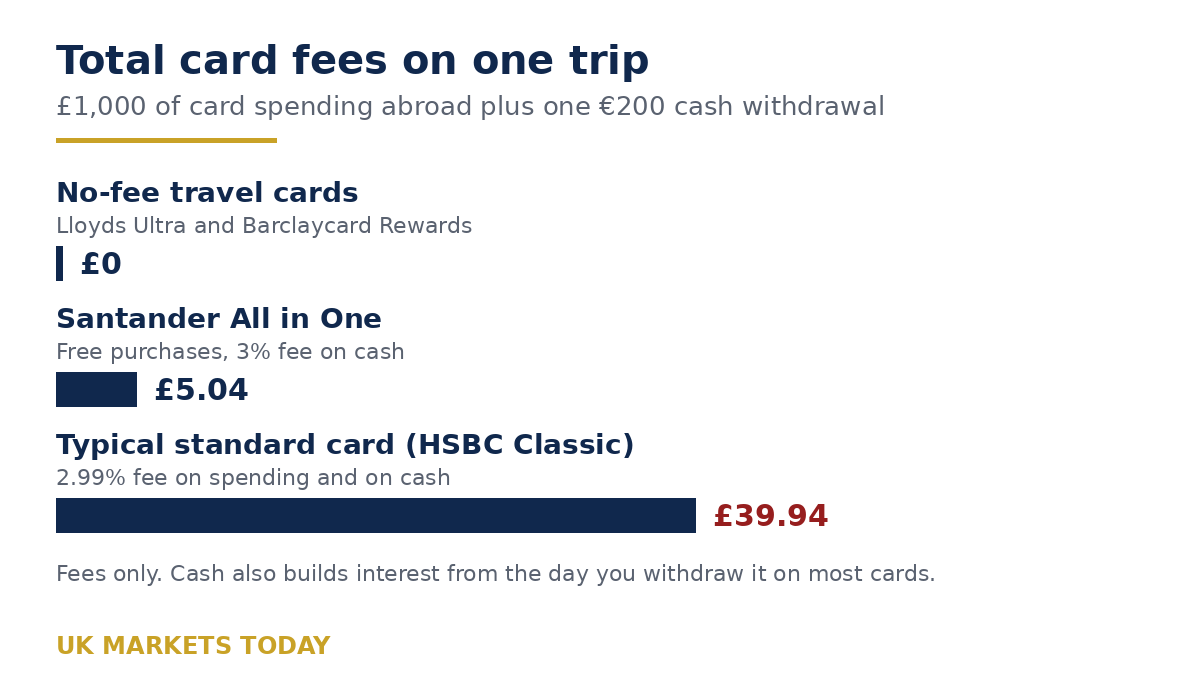
Cashback softens the bill on the no-fee cards. On that same £1,000 of spending, the Lloyds Ultra pays back £10 in its first year, the Barclaycard Rewards pays £2.50, and Santander pays £5.00, set against its £3 monthly fee.
Which cards charge no foreign transaction fee?
Three cards you can apply for today charge 0% on purchases abroad, all checked on the issuer’s own product page: Lloyds Ultra, Barclaycard Rewards and Santander All in One. The first two have no account fee. Santander charges £3 a month, and in return pays 0.5% cashback and offers long 0% periods, so it fits heavier spenders better than once-a-year holidaymakers.
You may notice a famous name missing. The Halifax Clarity card also charges 0% on purchases and on cash withdrawals abroad, checked on Halifax’s own card abroad page, and it leads most rival guides. It is not one of our three picks for one simple reason: you cannot apply for it. Lloyds Banking Group closed Halifax to new customers on 1 July 2026 as it retires the Halifax brand into Lloyds, so the Clarity is now held by existing customers only, at a representative APR of 23.9% variable. If you already have one, it remains an excellent travel card, and the table below includes it so you can compare what you hold.
| Card | Foreign fee on purchases | Cash withdrawals abroad | Representative APR | Cashback and account fee |
|---|---|---|---|---|
| Lloyds Ultra | 0% | No fee; interest is charged from the day you withdraw | 16.9% variable | 1% cashback in year one, then 0.25%; no monthly fee |
| Barclaycard Rewards | 0% | 0.00% fee on all cash withdrawals | 28.9% variable | 0.25% cashback; no monthly fee |
| Halifax Clarity (existing customers only, closed to new applicants) | 0% | No fee; interest is charged from the day you withdraw | 23.9% variable | No cashback; no monthly fee |
| Santander All in One | 0% when you pay in the local currency | 3% fee (minimum £3), plus interest at 29.9% a year from the day you withdraw | 29.8% variable | 0.5% cashback up to £10 a month; £3 monthly fee |
Fees and APRs checked on the Lloyds Bank, Barclays and Santander product pages on 14 October 2026. The Santander card also offers 0% on purchases for 15 months from opening, which can spread the cost of a big trip; our guide to 0% purchase credit cards explains how to use an offer like that without paying interest when it ends.
Is it better to pay in pounds or in the local currency?
Always the local currency. If you choose pounds, the shop, restaurant or cash machine converts the bill for you at its own rate, a practice called dynamic currency conversion, and that rate is almost always worse than your card provider’s rate. Santander spells it out on its own card page: choose pounds sterling and the retailer or bank may add a charge for handling the conversion itself.
The question appears on the card terminal or the cash machine screen, sometimes worded as a helpful offer to show you the price in pounds. Decline it. Choosing the local currency means Visa or Mastercard sets the rate instead, and even on a card that charges a foreign fee, the local currency route usually works out cheaper. The free MoneyHelper service has more guidance on cutting the cost of travel money.
Do travel credit cards charge for cash withdrawals?
Some do and some do not, and the interest matters more than the fee. Lloyds Ultra and Barclaycard Rewards charge no cash withdrawal fee at all. Barclaycard Rewards goes one step further, and no rival guide we checked states it clearly: its interest-free period, up to 56 days, also covers cash withdrawn abroad in a foreign currency, as long as you pay the balance in full and on time, per the Barclays summary box checked on 14 October 2026. Cash withdrawn in pounds does not get the same treatment, and interest can still apply to a balance carried over from the previous statement. Santander charges 3% (minimum £3) on cash even though its purchases are fee-free. On almost every credit card, interest on cash starts on the day you withdraw it, with no interest-free period, so a withdrawal you forget about keeps growing until you repay it.
Two habits keep cash cheap. First, pay by card wherever you can and treat cash as a backup for market stalls and tips. Second, if you do withdraw, repay that amount as soon as you can, ideally the same week, rather than waiting for the statement. A local cash machine operator may also add its own charge, which no card can remove, so check the screen before you confirm.
What happens to the exchange rate?
Your card provider converts each purchase at the Visa or Mastercard exchange rate for the day the payment is processed, which sits close to the rate you see quoted on the news. A card with no foreign transaction fee adds nothing on top of that rate. A card charging 2.99% takes its cut on every single transaction, which is how a small percentage becomes £29.90 on a £1,000 trip.
Because the rate is fixed when the payment is processed, not when you tap the card, the sterling amount on your statement can differ by a few pence from the figure you expected on the day. Both Visa and Mastercard publish free exchange rate calculators, so you can check roughly what a purchase should cost before you travel.
Which card is best if you have a poor credit score?
Most no-fee travel cards ask for a good credit history, but one credit builder card also skips the foreign fee: Zable charges no transaction fees abroad and no monthly fee, checked on its own site on 14 October 2026. Its interest rate is high and varies by applicant, so it only makes sense if you clear the balance in full. Most other builder cards do charge a foreign fee, so read the summary box before you travel.
Our guide to credit cards for bad credit explains how builder cards work, what they cost, and how to use one without making your score worse. If you are still rebuilding, a fee-free builder card plus small, fully repaid spending is a safe way to keep holiday costs down while your file improves.
What it means for your money
- The card already in your wallet can add about £30 to every £1,000 you spend abroad. Swapping to a no-fee card before a trip is one of the simplest savings in personal finance.
- Paying in pounds at the till is the costliest tap of the holiday. Always choose the local currency and let your card provider convert.
- A credit card protects holiday bookings. Purchases between £100 and £30,000 carry Section 75 protection, which helps if an airline or tour operator fails.
- A balance that follows you home keeps costing. Use our credit card payoff calculator to see what a fixed monthly payment really does to the total.
- Already carrying card debt? A 0% balance transfer can cut the interest while you clear it, as long as you count the transfer fee first.
FAQs about travel credit cards
Is it cheaper to use a debit card abroad?
Usually not by default. Many debit cards charge a non-sterling fee much like a standard credit card, and debit card purchases do not carry Section 75 protection. Some specialist current accounts are fee-free abroad, so check your own account’s charges before you decide what to pack.
Does using a credit card abroad affect my credit score?
Foreign spending is treated exactly like spending at home. It is reported in the same way, and what matters is paying on time and staying well within your limit. Applying for a new card does involve a hard search, which is why eligibility checkers, which use a soft search, come first.
When should I apply for a travel credit card?
Apply a few weeks before you travel, so the card has time to arrive and you can test it with a small purchase at home first. Applying for several cards in a short burst can dent your credit score, so pick one, check your eligibility, then apply once.
Can I use a travel credit card to book flights and hotels before I go?
Yes, and it is one of the best uses. Paying in a foreign currency counts as foreign spending, so a no-fee card saves on the booking as well as on the trip, and the booking itself gains Section 75 protection if it costs between £100 and £30,000.
How we checked. Every fee, APR and cashback figure in this guide was read on the issuer’s own product page or summary box on 14 October 2026: Lloyds Bank, Barclays, Santander, HSBC, Halifax and Zable. The note about the Halifax Clarity closing to new applicants follows Lloyds Banking Group’s July 2026 announcement that the Halifax brand is being retired. Card terms change, so always check the summary box before you apply. This guide is information only and is not financial advice. If you are unsure what is right for you, speak to a regulated adviser or start with the free MoneyHelper service.
Got a UK money question?
Ask it in the Ask UKMT live chat. No sign up, no names, and the answers are checked against official sources. Open the live chat