
Compound Interest Calculator UK: How to Grow Your Money Faster
Quick answer Compound interest pays interest on your interest. It is calculated with the formula A = P(1 + r)ᵗ. On this page’s example, £1,000 at 5.00% AER becomes £1,276.28 after five years, so £276.28 of the final amount is interest, and £26.28 of that is interest earned on earlier interest. Use the free calculator…

Quick answer
Compound interest pays interest on your interest. It is calculated with the formula A = P(1 + r)ᵗ. On this page’s example, £1,000 at 5.00% AER becomes £1,276.28 after five years, so £276.28 of the final amount is interest, and £26.28 of that is interest earned on earlier interest. Use the free calculator below to run your own numbers.
If you’re searching for a compound interest calculator, you’re already thinking like someone who wants to grow money smarter, not harder. In the UK, understanding how compound interest works can make a huge difference to savings, investments, pensions, and long-term financial security.
A compound interest calculator helps you estimate how your money grows over time by earning interest not just on your original deposit, but also on the interest already added. This “interest on interest” effect is what makes compounding one of the most powerful tools in personal finance.
In this guide, we’ll explain how compound interest works, how to use a calculator properly, and how UK savers can maximise returns using practical strategies.
Quick answer: how interest is calculated
Compound interest is calculated with one formula: A = P(1 + r)ᵗ, where A is the final amount, P is your starting amount, r is the annual interest rate as a decimal (so 5% becomes 0.05) and t is the number of years. In plain words: multiply your starting amount by 1 plus the rate, once for every year the money is left to grow.
Worked example: £1,000 in an account paying 5.00% AER becomes £1,050 after one year and £1,102.50 after two years, because each year the 5% applies to the whole growing balance, not just the original £1,000. After five years it reaches £1,276.28. That is £276.28 of interest, and £26.28 of it is interest earned on earlier interest, which is the compounding effect doing its work.
The 5.00% AER used here is the best easy access savings rate we found when checking the market for our October 2026 guide to the best savings accounts in the UK (Starling and LemFi). Rates move, so check that guide for the current top rates before you rely on any figure.
Try the free compound interest calculator
Compound Interest Calculator
See what a starting amount plus a monthly addition could grow to, and how much of the final value is interest. Illustrative only.
Enter 0 if you are not adding money each month.
Total you put in:
Interest earned:
| Year | Value | Interest earned so far |
|---|
Illustrative: interest is added monthly at the rate you entered divided by 12, and each monthly addition lands at the end of the month. Real accounts may work interest out daily, pay it monthly or yearly, and rates change over time, so treat the figures as a guide, not a promise.
What Is Compound Interest Calculator?
Compound interest is the process where your money earns interest, and then that interest also earns interest over time.
Simple Example:
- You invest £1,000
- Earn 5% annually
- After 1 year → £1,050
- Next year → interest is calculated on £1,050 (not £1,000)
Over time, this creates exponential growth.
Why a Compound Interest Calculator Matters
A compound interest calculator helps you:
- Predict future savings growth
- Compare different interest rates
- Plan investments or retirement
- Understand long-term financial impact
Instead of guessing, you see real projections.
Compound Interest Calculator Formula Explained
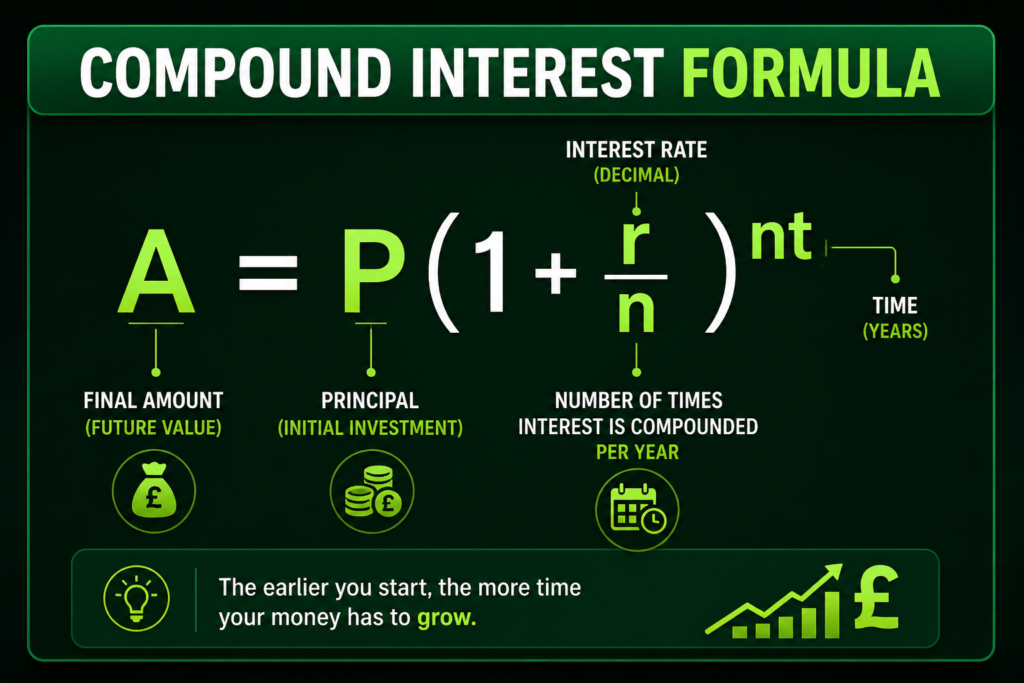
The basic formula is:
A = P (1 + r/n)ⁿᵗ
Where:
- A = Final amount
- P = Initial investment
- r = Interest rate
- n = Compounding frequency
- t = Time in years
But realistically, most people prefer using a calculator instead of doing manual calculations.
How to Use a Compound Interest Calculator (UK Example)
Let’s break it down simply.
Step 1: Enter Initial Amount
Example: £5,000
Step 2: Add Monthly Contributions
Example: £200 per month
Step 3: Choose Interest Rate
Example: 6% annually
Step 4: Select Time Period
Example: 10–20 years
Step 5: Choose Compounding Frequency
Usually:
- Monthly
- Quarterly
- Annually
The calculator then shows:
- Total contributions
- Interest earned
- Final value
Real UK Example of Compound Growth
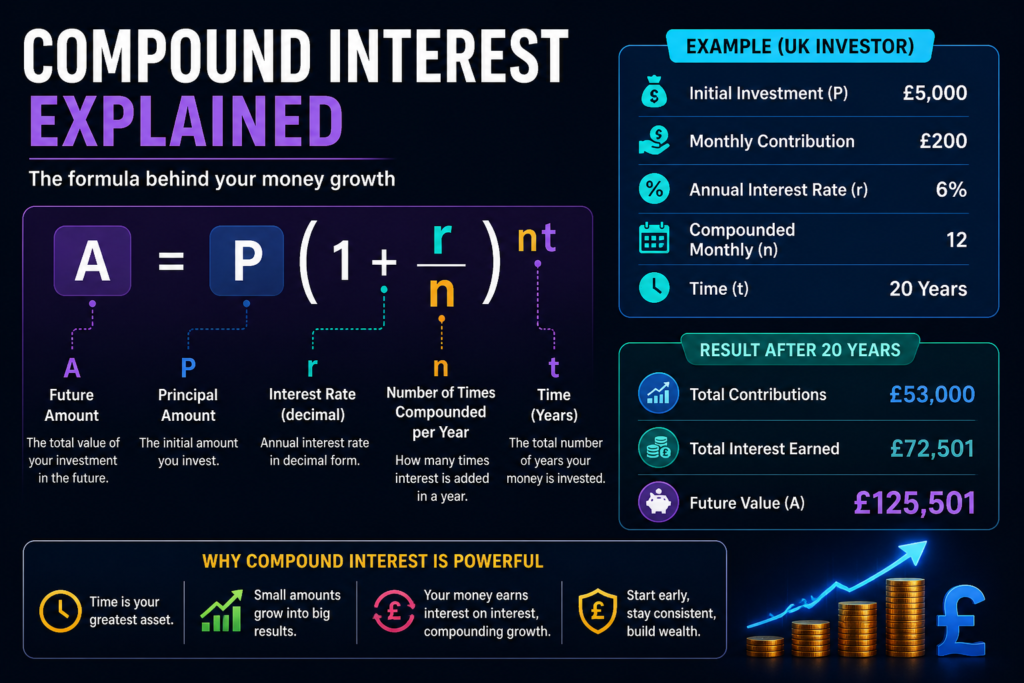
Let’s say:
- £5,000 initial investment
- £200 monthly
- 6% a year, interest added monthly
- 20 years
Result:
- Total invested: ~£53,000
- Final value: ~£109,000
That’s £56,000 growth just from compounding
What £1,000, £5,000 and £10,000 grow to at 5.00% AER
The table below applies the formula above at 5.00% AER, compounded once a year, with no money added or withdrawn and the rate held steady. The interest figures come from our October 2026 best savings accounts research.
| Starting amount | After 5 years | After 10 years | After 20 years |
|---|---|---|---|
| £1,000 | £1,276.28 | £1,628.89 | £2,653.30 |
| £5,000 | £6,381.41 | £8,144.47 | £13,266.49 |
| £10,000 | £12,762.82 | £16,288.95 | £26,532.98 |
Compare that with simple interest, where you earn 5% on the original sum only: £1,000 would be worth £1,250 after 5 years, £1,500 after 10 years and £2,000 after 20 years. Compounding adds an extra £653.30 over 20 years on that £1,000, and the gap keeps widening the longer the money stays put. Put the same money in a cash ISA and the growth is identical, but the interest is never taxed: our guide to the best cash ISA rates shows the current top accounts.
Why Time Matters More Than Interest Rate
Most beginners focus on interest rates.
But the real driver is time.
Example:
| Years | Result |
|---|---|
| 10 years | Moderate growth |
| 20 years | Strong growth |
| 30 years | Massive growth |
The longer you stay invested, the more powerful compounding becomes.
Compound Interest Calculator in UK Savings & Investments
In the UK, compound interest applies to:
Savings Accounts
- Lower returns
- Safer
- Easy access
Stocks & Shares ISAs
- Higher long-term growth potential
- Tax-efficient
- Market risk involved
Pensions
- Long-term compounding
- Tax advantages
- Employer contributions
How to Maximise Compound Interest Calculator
1. Start Early
Time multiplies growth more than money.
2. Invest Regularly
Monthly contributions accelerate compounding.
3. Reinvest Earnings
Don’t withdraw returns too early.
4. Use Tax-Efficient Accounts
ISAs protect your gains from tax.
5. Avoid High Fees
Fees reduce compounding significantly over time.
Common Mistakes to Avoid
Waiting Too Long to Start
Delaying even 5 years reduces long-term gains massively.
Ignoring Inflation
Real returns are lower after inflation.
Chasing High Returns
Higher returns often come with higher risk.
Stopping Contributions
Consistency matters more than amount.
Compound Interest Calculator vs Simple Interest Calculator
| Feature | Compound | Simple |
|---|---|---|
| Growth | Exponential | Linear |
| Best for | Investments | Short-term loans |
| Returns | Higher long-term | Lower |
Compound interest always wins over time.
Is a Compound Interest Calculator Always Accurate?
It gives estimates, not guarantees.
Actual results depend on:
- Market performance
- Interest rate changes
- Inflation
- Fees
Still, it’s one of the best planning tools available.
Final Thoughts
Using a compound interest calculator is one of the smartest ways to understand how your money can grow over time. While the concept may seem simple, its long-term impact is powerful, especially for UK savers who take advantage of consistent investing and tax-efficient accounts.
The key is not just understanding compound interest, but actually applying it:
- Start early
- Stay consistent
- Think long-term
Small actions today can lead to significant financial growth tomorrow.
Frequently Asked Questions (FAQ)
What is a compound interest calculator?
A compound interest calculator helps estimate how your money grows over time by calculating interest on both your initial investment and accumulated interest.
How accurate is a compound interest calculator?
It provides estimates based on fixed assumptions. Real returns may vary depending on market conditions and interest rates.
What is the best interest rate for compounding in the UK?
It depends on the investment type. Savings accounts offer lower rates, while stocks and ISAs may provide higher long-term returns.
Can I use a compound interest calculator for monthly savings?
Yes. Most calculators allow you to add regular monthly contributions for more accurate projections.
How can I maximise compound interest Calculator?
Start early, invest consistently, reinvest returns, and use tax-efficient accounts like ISAs.
How is interest calculated on a savings account?
UK banks work out interest on your balance day by day, then pay it monthly, quarterly or yearly depending on the account. The daily sum is your balance multiplied by the yearly rate, divided by 365. AER, the Annual Equivalent Rate, rolls all of this up into one figure, so you can compare accounts fairly: it shows what you earn over a full year if the interest stays in the account and compounds.
Is savings interest calculated monthly or yearly?
It is calculated daily, but paid into your account monthly, quarterly or once a year, depending on the account. If monthly interest is left in the account, it starts earning interest itself from the following month. On £1,000 at a 5% gross rate, monthly compounding gives £1,051.16 after one year, against £1,050.00 if interest is paid once at the end of the year. This is why UK accounts quote AER: it builds the compounding in, so the AER is the true yearly figure whatever the payment schedule.
How much interest will I earn on £1,000 in a savings account?
At 5.00% AER, the best easy access rate in our October 2026 checks, £1,000 earns £50 in the first year. Leave it untouched and compounding takes the pot to £1,276.28 after five years and £2,653.30 after twenty years. At 1.00% AER the first year earns just £10, which is why the rate you choose matters as much as the amount you save. See our best savings accounts guide for the rates available now.
What does AER mean?
AER stands for Annual Equivalent Rate. It is the rate you actually earn over a full year once compounding is included, which makes it the fair way to compare accounts that pay interest at different times. A monthly paying account might quote a gross rate of 4.89%, but its AER is 5.00%, because the interest paid each month goes on to earn interest too. Always compare AER with AER.
Do I pay tax on savings interest in the UK?
Most savers pay none. Your Personal Savings Allowance lets a basic rate taxpayer earn £1,000 of savings interest a year tax free; higher rate taxpayers get £500, and additional rate taxpayers get no allowance. Interest inside a cash ISA is always tax free and never uses up the allowance. At 5.00% AER, a basic rate taxpayer would need about £20,000 saved before the interest alone used up the £1,000 allowance.
Nominal growth vs real growth: don’t forget inflation
A calculator shows nominal growth, the number on the screen. What matters for your plans is real growth: what that money will actually buy. As a rough illustration, £10,000 compounding at 5% a year for 10 years grows to about £16,289. But if inflation averages 3% over the same period, that £16,289 has the buying power of roughly £12,100 in today’s money.
When you set a target, a house deposit, a retirement pot, estimate it in today’s prices first, then add a margin for inflation, rather than trusting the nominal figure alone.
Simple interest vs compound interest
With simple interest, you earn interest only on your original deposit: £10,000 at 5% simple interest for 10 years gives you £15,000. With compound interest, each year’s interest starts earning interest itself, the same £10,000 at 5% compounded annually reaches about £16,289. The gap widens dramatically over longer periods, which is why starting early matters more than finding a slightly higher rate.
Using the calculator for real-life goals
- House deposit: enter your current savings, monthly contribution and timeframe to see whether your target deposit date is realistic.
- Retirement: small monthly contributions over 20–30 years show the power of compounding, and how much delay costs.
- Emergency fund: work backwards from your target (say, 3–6 months of expenses) to find the monthly amount that gets you there.
Common mistakes when projecting growth
- Ignoring fees and charges. Platform fees, fund charges and advice costs all drag on the compounding the calculator assumes.
- Assuming constant returns. Investments do not grow in a straight line, run a lower-rate scenario too, so your plan survives a bad decade.
- Forgetting tax. Savings interest above your Personal Savings Allowance is taxable, and investment growth outside an ISA or pension may face dividend or capital gains tax. Tax wrappers exist precisely to protect compounding.
- Comparing nominal figures across decades. Always sanity-check long-range projections against inflation, as above.
Last updated: October 2026.
Got a UK money question?
Ask it in the Ask UKMT live chat. No sign up, no names, and the answers are checked against official sources. Open the live chat