How to Invest in the S&P 500 from the UK
How to invest in the S&P 500 from the UK: the ISA route, fund charges from 0.03% checked 22 Oct 2026, withholding tax and currency maths on £10,000, and S&P 500 vs a global fund.
TL;DR: how to invest in the S&P 500 from the UK
You invest through a UK platform, inside a stocks and shares ISA where you can, by buying a London listed S&P 500 index fund or ETF. You cannot buy the index itself. The cheapest funds checked today charge 0.03% to 0.07% a year, but that is not the whole cost: withholding inside the fund and moves in the pound both change what you keep. Verdict on the facts checked today: an Ireland domiciled, accumulating UCITS fund inside an ISA is the cleanest route for most UK investors who choose this index, because it avoids UK tax on growth and dividends while keeping withholding at 15%. That is a verdict about the route, not advice to invest. Last checked: 22 October 2026. General information only, not financial advice.
The S&P 500 is a list of about 500 large US companies. A tracking fund holds them in roughly the same proportions, so one purchase spreads your money across all of them. This guide shows the UK route, totals the real costs in pounds, and answers whether you need this fund if you already hold a global fund. New to index funds? Our global index fund guide explains the worldwide version first.
How do you invest in the S&P 500 from the UK?
You open a stocks and shares ISA or a general investment account with a UK platform, pay money in, and buy a London listed fund or ETF that tracks the S&P 500. The fund does the buying of the US shares for you. You never deal with a US exchange, a US broker or US dollars directly.
The steps in plain order:
- Choose the account first. An ISA shelters growth and dividends from UK tax. A general account does not.
- Choose the fund type. Most UK investors use a UCITS ETF or index fund domiciled in Ireland and listed in London, the standard UK platforms can sell to UK retail investors.
- Pick accumulating or distributing. Accumulating reinvests dividends inside the fund. Distributing pays them out as cash. Inside an ISA, accumulating is usually simpler.
- Check the total cost, not just the fund charge. Platform charges, dealing costs and spreads all count. Section three totals them.
- Buy in pounds on the London exchange. Some funds trade in pounds and some in dollars in London; a pounds version can save a conversion fee on some platforms.
Our best trading platforms guide compares UK platforms on charges. A cheap fund on an expensive platform is not a cheap investment.
Can you hold an S&P 500 fund in an ISA?
Yes. A London listed S&P 500 UCITS fund is a normal ISA investment. You can put up to the full £20,000 allowance for 2026/27 into a stocks and shares ISA, and GOV.UK confirms you pay no tax on income or capital gains in an ISA. Unused allowance does not carry forward.
Outside an ISA, gains above the £3,000 capital gains allowance for 2026/27 can be taxed when you sell, and dividends above the £500 dividend allowance can be taxed as income. Our capital gains allowance guide works through those rules. Inside an ISA, neither UK charge applies.
One limit an ISA cannot remove: tax taken inside the fund itself. That is the withholding tax in section four. An ISA stops UK tax on top; it does not undo tax already taken.
What does it cost in total?
The fund charge on the main S&P 500 trackers checked today runs from 0.03% to 0.07% a year. On £10,000 that is £3 to £7 a year, taken inside the fund, so you never see a bill. Your platform charge and any dealing costs sit on top, and for many investors the platform charge is the bigger number.
| Fund (example, London listed) | Ticker | Ongoing charge | Cost on £10,000 for one year | Income treatment and structure |
|---|---|---|---|---|
| State Street SPDR S&P 500 UCITS ETF | SPXL | 0.03% | £3.00 | Accumulating, physical |
| Invesco S&P 500 UCITS ETF | SPXS | 0.05% | £5.00 | Accumulating, swap based (synthetic) |
| iShares Core S&P 500 UCITS ETF | CSPX | 0.07% | £7.00 | Accumulating, physical, Ireland domiciled |
| Vanguard S&P 500 UCITS ETF (Acc) | VUAG | 0.07% | £7.00 | Accumulating, physical, Ireland domiciled |
| Vanguard S&P 500 UCITS ETF (Dist) | VUSA | 0.07% | £7.00 | Distributing, pays income out, Ireland domiciled |
Charges checked 22 October 2026 against providers’ published costs: Vanguard’s costs document lists VUAG and VUSA at 0.07% (Vanguard costs and charges information), and the SPDR profile lists SPXL at 0.03% (SPXL fund profile). Examples only, not a recommendation. Charges can change, so check the key investor document on the day.
The worked example: £10,000 for one year. In a fund charging 0.07%, the fund charge is £7.00. If your platform charges an example 0.25%, that is £25.00, so the two cost £32.00 before dealing costs and spreads. Now the costs most guides miss. If the fund received £130 of dividends on your £10,000 (a stated 1.3% example, not a promise of yield), withholding at 15% takes £19.50 inside the fund, leaving £110.50. A 5% pound move can change the £10,000 by around £500. The fund charge is the smallest cost here.
What is US dividend withholding tax and how does it affect UK investors?
When a US company pays a dividend, tax can be taken before the money leaves the US. For an Ireland domiciled fund holding US shares, withholding is 15% of the dividend, taken inside the fund. You never see the dividend or the tax bill; the fund simply grows by a little less.
The 15% figure is the treaty rate. HMRC’s Double Taxation Relief Manual lists UK-US portfolio dividends at a 15% treaty maximum, and Ireland’s treaty with the US gives its funds the same 15% rate. Without a treaty the US default is 30%, one reason UK investors use Ireland domiciled funds instead of US listed funds such as VOO.
Three facts to hold on to. Withholding happens inside an ISA too, because it is taken at fund level. You cannot reclaim it; the £19.50 in the worked example is a real drag, just smaller than the 30% alternative. And it applies only to dividends, not to growth in share prices.
What happens when the pound moves against the dollar?
Your fund holds US shares priced in dollars, so the exchange rate sits between you and your money. If US shares stay flat in dollars and the pound gets stronger, your holding falls in pounds. If the pound gets weaker, your holding rises in pounds, even if the US shares did nothing at all.
The maths on £10,000, with US shares flat so only the currency moves:
- You invest at £1 = $1.30, so your £10,000 buys $13,000 of US shares.
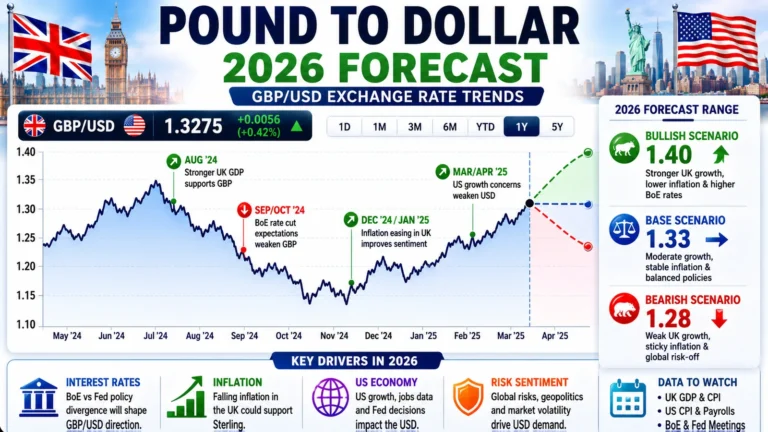
- The pound strengthens 5% to £1 = $1.365. Your $13,000 is now worth $13,000 divided by 1.365 = £9,523.81. You have lost £476.19 without a single US share price moving.
- The pound weakens 5% to £1 = $1.235. Your $13,000 is now worth $13,000 divided by 1.235 = £10,526.32. You have gained £526.32, again with no share price move.
This cuts both ways and nobody can forecast it reliably. Some funds offer a hedged version that tries to cancel out currency moves, for an extra cost; hedging removes the gains from a weak pound as well as the losses from a strong one. Our FTSE 100 index guide covers the UK index, priced in pounds.
S&P 500 fund or global fund: which should a UK investor pick?
An S&P 500 fund is a bet on one country: the United States. A global fund spreads across the US, the UK, Europe, Japan and other markets. A global fund already holds roughly six pounds in every ten in US shares, so adding an S&P 500 fund mostly adds more of what you already own.
Choose the comparison on facts, not fashion:
| Question | S&P 500 fund | Global fund |
|---|---|---|
| What you own | About 500 large US companies only | Companies across many countries, with the US the biggest share |
| Currency risk | Almost all in dollars | Spread across dollars, pounds, euros, yen and others |
| Typical fund charge | 0.03% to 0.07% (checked today) | Usually a little higher, still low |
| Main risk | One country, one currency, heavy weight in large US technology firms | Still falls when world markets fall, just less tied to one country |
Neither choice is right for everyone, and this page does not pick one for you. If you hold a global fund, read its factsheet before adding a US fund, so you know your true US weight. If you hold neither, the global route is the simpler one fund answer; the S&P 500 route is a deliberate US tilt. Our global index fund guide shows that side in full, and our cash ISA vs stocks and shares ISA guide helps if you are still deciding whether investing suits this money.
What are the risks?
The value of an S&P 500 fund can fall, sometimes sharply, and you could get back less than you put in. The index has fallen by more than 20% in bad years in the past. That does not predict future falls, but it shows the drop a holder must be able to sit through.
The risks in one list:
- Market risk. US shares as a whole can fall and stay down for years.
- Concentration risk. The index is weighted by company size, so a small group of very large US firms makes up a big share of it. You are less spread than the number 500 suggests.
- Currency risk. As section five shows, a 5% move in the pound can add or take away around £500 on £10,000.
- Cost and tax drag. Fund charges, platform charges and withholding are small each year and certain, unlike returns, which are neither.
- Time risk. Money you need in the next few years, for a house deposit or a known bill, is exposed if a fall lands just before you need it. A cash ISA or savings account does not fall in value in that way.
The trap: buying the American version, or buying the same thing twice
The trap most UK readers walk into is buying a US listed fund, such as the American VOO, because its 0.03% headline charge looks cheaper than a UK listed fund at 0.07%. That saving is usually a false economy. US listed funds are not UCITS funds, most UK platforms cannot sell them inside an ISA, dividends face US withholding directly, and US estate tax rules can bite on larger holdings. The Ireland route keeps a UK investor inside UK accounts and rules.
The second trap is quieter: holding a global fund and an S&P 500 fund side by side and calling it diversification. A global fund is already mostly US shares, so the pair is one big US holding with two labels: tax you did not expect, or a fall that hits harder than planned.
What it means for your money
Put the costs in order. On £10,000, the gap between the cheapest and dearest fund in our table is £4 a year. The example platform charge is £25. Withholding on the example dividends is £19.50. A 5% currency move is about £500. The fund charge, which most guides lead with, is the smallest number here.
What moves your outcome is the account (an ISA removes UK tax on growth and dividends), the platform total, and whether a US only holding is the risk you meant to take. Get those right and the choice between trackers at 0.03% and 0.07% is a £4 a year detail. If you are unsure whether investing suits you, free guidance is available from MoneyHelper; regulated advice is a paid, personal service this page is not.
Frequently asked questions
Can I buy the S&P 500 directly?
No. The S&P 500 is an index, a calculated list, not a share. You buy a fund or ETF that tracks it, through a UK platform, and the fund holds the shares.
What is the minimum I can invest in an S&P 500 fund from the UK?
It depends on the platform, not the fund. Many UK platforms let you start with a small monthly payment or a lump sum of £25 to £100, and some let you buy fractions of a share. Check the platform’s minimums first.
Is an accumulating or a distributing S&P 500 fund better?
Neither is better in itself. Accumulating reinvests dividends inside the fund, simpler inside an ISA. Distributing pays them as cash, which suits people who want income paid out. Outside an ISA, accumulating funds still create tax paperwork on income never received as cash.
Do I pay US tax on an S&P 500 fund in an ISA?
You pay no UK tax inside an ISA. Withholding tax is still taken inside the fund on US dividends, at 15% for an Ireland domiciled fund, before the money reaches your account. You do not file a US tax return for holding a UK listed fund.
S&P 500 or FTSE 100: what is the difference?
The S&P 500 covers large US companies priced in dollars. The FTSE 100 covers the largest companies listed in London, priced in pounds, although many earn most of their money abroad. Different countries, sectors and currencies, so they do not move in step.
Can I lose money in an S&P 500 fund?
Yes. The value can fall and you could get back less than you invested, especially over short periods. Only invest money you can leave alone for years, and keep money you need soon in cash accounts instead.
Do this next, in this order
- Decide if this money can be invested at all. If you need it within the next few years, keep it in cash.
- Use your ISA allowance first. The 2026/27 allowance is £20,000 and the tax year ends on 5 April 2027. Allowance you do not use by then is lost.
- Compare platforms on total cost. Add the platform charge, dealing costs and any currency conversion fee. Use our platforms guide, then read the platform’s own charges page.
- Pick one Ireland domiciled UCITS tracker. Check its ongoing charge, whether it is accumulating, and whether it trades in pounds, in its key investor document on the day.
- Check you are not doubling up. If you already hold a global fund, work out your combined US weight before you buy more US shares.
- Invest, then leave it alone. Note the date, the fund and the total charges in one place, and review once a year rather than after every headline.
Sources and checking: fund charges checked 22 October 2026 against provider published costs (Vanguard costs document and fund profiles linked above). ISA rules from GOV.UK, Individual Savings Accounts: How ISAs work. Withholding treaty rate from HMRC’s Double Taxation Relief Manual (DT19852). The £130 dividend figure and the 0.25% platform charge are stated examples used to show the maths, not current market rates. This page is general information about how this type of investing works. It is not financial advice and it does not recommend any fund or platform for you.
Got a UK money question?
Ask it in the Ask UKMT live chat. No sign up, no names, and the answers are checked against official sources. Open the live chat