
Soft vs Hard Credit Search UK: Does Checking Your Score Hurt It?
If you are checking your credit score, you may worry that looking at it will make it worse. The good news is that checking your own credit report is normally a soft search, so it does not affect your credit score. A full application for a loan, credit card, mortgage or some other credit product…

If you are checking your credit score, you may worry that looking at it will make it worse. The good news is that checking your own credit report is normally a soft search, so it does not affect your credit score. A full application for a loan, credit card, mortgage or some other credit product may create a hard search, which lenders can see and which may affect how they judge further applications.
This guide explains the difference in simple language. It also shows what to do before applying for credit, so you can avoid unnecessary applications. If you want to improve your wider profile, see our guide to improving your UK credit score and our guide to UK credit score ranges.
Quick answer: Checking your own credit report or using an eligibility checker normally uses a soft search. It should not lower your score. A full credit application may create a hard search. Too many hard searches close together can look risky to lenders, so compare first and apply only when you are ready.
Important: This is general UK financial information, not personal financial advice. Credit reference agencies and lenders can use different systems. Always read the provider’s wording before submitting an application.
Quick answer: what does a soft credit check show UK lenders?
A soft check lets a company confirm who you are and see a summary of your credit history, enough to give you a quote or an eligibility result. The search is recorded on your credit report, but only you can see it. Other lenders cannot see soft searches, and a soft check never affects your credit score. A hard search is different: it follows a full application, every lender can see it, and several hard searches in a short time can make lenders cautious.
Checked: October 2026.
What is a credit search?
A credit search happens when a company checks information about you for a reason such as identity checking, eligibility or a credit application. The search may be recorded on your credit report.
There are two main types:
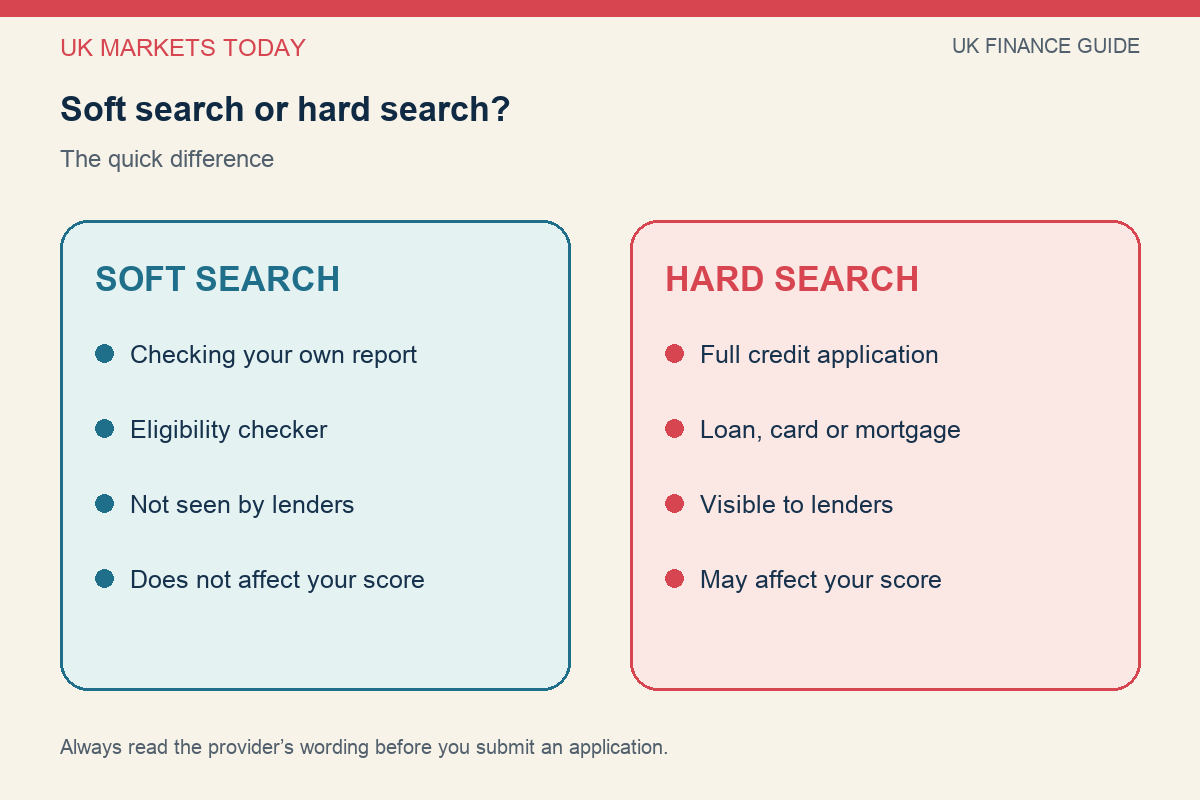
- Soft search: a lighter check that is not visible to other lenders and does not affect your score.
- Hard search: a formal check connected with a credit application. It can be visible to lenders and may affect your score or how a lender views a new application.
The exact information a company sees depends on why it is checking your report and which credit reference agency it uses. Experian, Equifax and TransUnion do not use identical systems, so your reports may not look exactly the same.
What is a soft credit search?
A soft search is usually used when a company does not need to record a full application. Common examples include:
- checking your own credit report;
- using a credit-score service;
- using an eligibility checker before applying;
- comparing some loan or credit-card offers; and
- an identity or background check in some situations.
Soft searches are useful because they let you learn more before making a full application. MoneyHelper explains that a soft search is not visible to other lenders and does not affect your credit score.
Simple example
Imagine you want to know whether you are likely to qualify for a credit card. An eligibility checker may ask for some information and show a result without making a full application. That is usually a soft search.
It is not a promise that your application will be accepted. The lender can still make a full assessment later.
What is a hard credit search?
A hard search is normally connected with a full application for credit. It may happen when you apply for:
- a loan;
- a credit card;
- a mortgage;
- a hire-purchase or car-finance agreement; or
- some mobile-phone contracts.
A hard search is recorded on your credit report and can be visible to credit providers. One hard search does not automatically mean your application will be rejected. However, several applications in a short period can make it look as though you are urgently seeking credit.
A hard search is not the only thing a lender considers. Lenders can also look at your income, affordability, existing debts, payment history, address history and their own lending rules.
Does checking your own credit score hurt it?
Normally, no. Looking at your own credit report is not the same as applying for credit. It is generally treated as a soft search and should not lower your score.
You should still be careful about what button you press. A page may offer both:
- an eligibility check or quotation; and
- a full application.
Read the wording before continuing. If it says that the provider will make a full application or a hard search, stop and make sure you are ready.
Soft search versus hard search: the difference
| Question | Soft search | Hard search |
|---|---|---|
| Can you use it to check your own report? | Yes | No, not normally |
| Is it usually visible to other lenders? | No | Yes |
| Does it normally affect your score? | No | It may |
| Is it linked to a full application? | Usually no | Usually yes |
| Is it useful before applying? | Yes | Only when you are ready to apply |
Everyday checks: soft or hard?
Most confusion comes from everyday moments, not from the definitions. This table shows which type of search usually happens. If a form says the check will not affect your credit score, it is a soft search.
| Everyday moment | Soft or hard? |
|---|---|
| Checking your own score or report (Experian, ClearScore, Credit Karma) | Soft |
| Credit card or loan eligibility checker | Soft |
| Insurance quote or car insurance quote | Usually soft |
| Buy now, pay later at the checkout | Usually soft for the check itself |
| Landlord or letting agent check | Soft |
| Employer background check | Soft |
| Mortgage agreement in principle | Usually soft, but a few lenders use a hard search, so ask first |
| Applying for a credit card, loan or overdraft | Hard |
| Full mortgage application | Hard |
| Mobile phone contract | Hard |
| Car finance application | Hard |
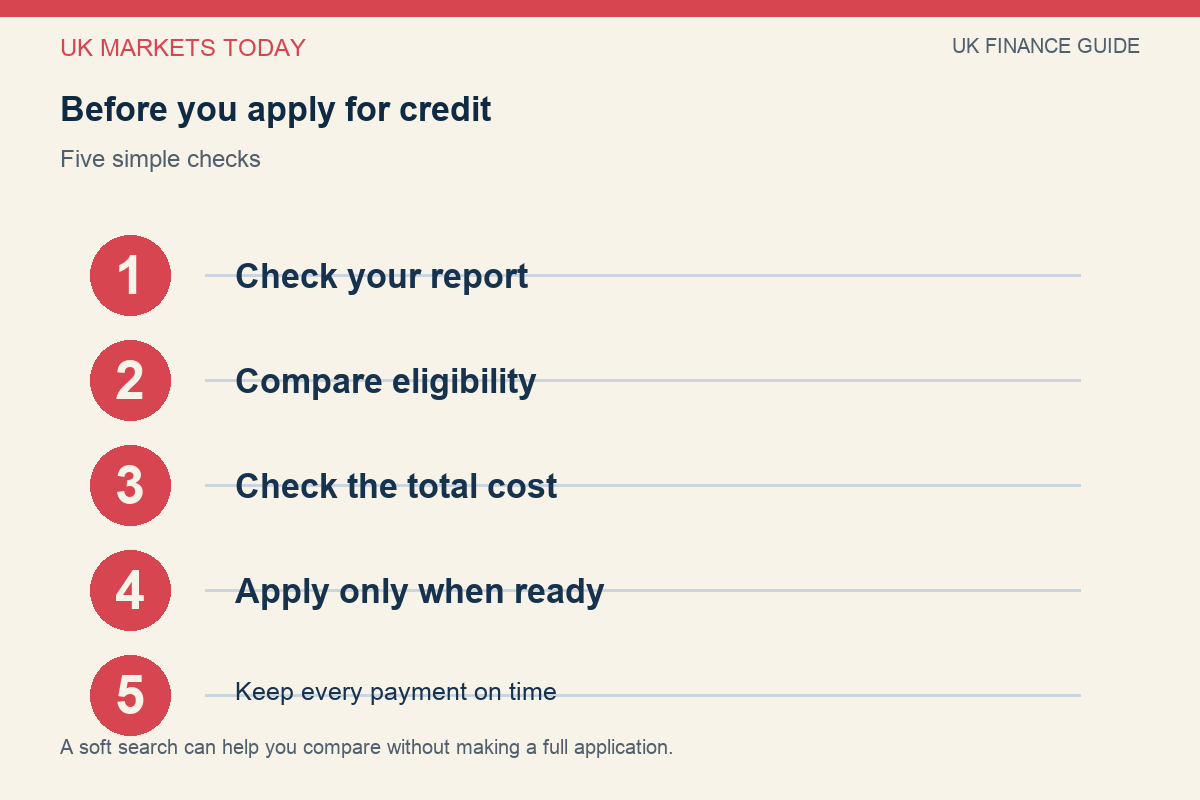
Five steps before applying for credit
1. Check your credit reports
Look for incorrect names, addresses, accounts, missed-payment records or searches you do not recognise. You can ask the relevant credit reference agency to investigate inaccurate information.
Checking your own information should not hurt your score.
2. Use an eligibility checker first
If one is available, use an eligibility checker before making a full application. It may give you an indication of how likely you are to be accepted without creating a hard search.
Treat the result as an estimate. It is not an approval.
3. Compare the full cost
Do not choose a product only because it says “accepted” or shows a high limit. Check the interest rate, fees, repayment amount, total cost and any conditions.
A product that is easy to apply for can still be expensive.
4. Apply only when the product fits
Avoid sending several full applications just to see what happens. Decide which product best fits your needs and affordability before you apply.
Do not take out credit simply to change your score.
5. Keep payments on time
After you borrow, make payments on time and follow the agreement. A history of missed payments can matter more to a lender than a single search.
What if you see a search you do not recognise?
Do not ignore it. First check whether it could be an eligibility check, an account review or a company using a different trading name. If you still do not recognise it:
- contact the credit reference agency that shows the search;
- ask the company named in the entry to explain it;
- check your accounts for signs of fraud; and
- consider reporting suspected identity theft through the appropriate UK fraud-reporting route.
Keep copies of your messages and any reference numbers. Do not make another credit application just because you are worried about the entry.
Common mistakes to avoid
- Assuming every credit check is a hard search.
- Applying to several lenders on the same day without checking the search type.
- Treating an eligibility result as a guaranteed approval.
- Looking only at the monthly payment and ignoring the total cost.
- Believing that a credit score alone decides whether you will be accepted.
- Applying for credit you cannot comfortably afford.
Frequently asked questions
Can I check my credit score more than once?
Yes. Checking your own credit information is normally a soft search and should not lower your score. Check the terms of the service you are using so you know whether you are viewing your report or starting an application.
Is a soft search a guarantee that I will be accepted?
No. It is an indication based on the information available at that stage. A lender can make further checks and apply its own affordability and risk rules.
How many hard searches are too many?
There is no universal safe number. Lenders use different systems and look at the wider application. The sensible approach is to avoid unnecessary full applications and apply only when the product is suitable.
Do all lenders use the same credit score?
No. Credit reference agencies use different scales and lenders may use their own scoring and affordability checks. This is why one score should not be treated as a guaranteed lending grade.
Will a rejected application damage my credit score?
The hard search linked to an application may be visible and may affect how later applications are assessed. A rejection can also have other causes, such as affordability or the lender’s own policy. Avoid immediately applying to many other providers without understanding what happened.
What does a soft credit check show on my report?
It shows the date of the search, who ran it and that it was a soft search. Only you can see soft searches when you view your own report. Lenders looking at your report cannot see them at all.
How long does a hard search stay on my credit report?
Typically around 12 months. Its effect fades much sooner than that: lenders care most about the last few months, so a single hard search from a genuine application rarely matters for long. Several hard searches in a few weeks send a worse signal than the same searches spread over a year.
Does a mortgage agreement in principle do a hard search?
Most lenders use a soft search for an agreement in principle, but a few still use a hard search, so ask before you apply if you are protecting your report for another application. The full mortgage application always involves a hard search.
Final takeaway
Checking your own credit score is normally safe. The main risk comes from making several full credit applications without comparing first.
Use soft searches and eligibility checkers where available, read the wording carefully, check the total cost and apply only when the product is affordable and suitable for you.
Sources and review date
Reviewed 16 September 2026 using public guidance from:
- MoneyHelper: How to check your credit report for free
- MoneyHelper: How to improve your credit score
- Experian: Searches on your report: soft and hard credit checks
- Equifax UK: Soft credit searches versus hard credit searches
Rates, lender criteria and credit-reference-agency explanations can change. Check the current provider wording before applying.
Can you remove a hard search from your credit report?
A hard search stays on your UK credit file for about 12 months. An accurate hard search, one that resulted from an application you genuinely made, cannot be removed early, no matter what some “credit repair” firms claim.
What you can challenge is an inaccurate hard search: one you did not authorise, a duplicate entry, or a search linked to a financial associate you are no longer connected to. The process is:
- Check all three agencies. A search may appear with Experian, Equifax or TransUnion but not the others, check each file before disputing.
- Contact the lender first. If they agree the search was recorded in error, they can ask the agency to remove it.
- Raise a dispute with the agency. Each credit reference agency has a formal disputes process and must investigate, usually within 28 days.
- Escalate if needed. If the lender or agency will not correct a genuine error, you can take the complaint to the Financial Ombudsman Service.
While you wait, avoid making further applications: each new hard search adds another mark, and several in quick succession can worry lenders more than any single search.
Soft vs hard searches: a real-world example
Imagine you want a new credit card. You use a comparison site’s eligibility checker to see which cards you are likely to be accepted for, that is a soft search. It is visible only to you and does not affect your score, so you can check as many cards as you like.
You pick a card and submit the full application, that is a hard search. It is recorded on your file and visible to other lenders for about a year. The same pattern applies to mortgages: an agreement in principle is usually a soft search, while the full mortgage application that follows is a hard one.
The practical rule: compare with soft searches, apply once with a hard search, and only apply when you are reasonably confident of acceptance.
Your credit score: keep reading
Understanding searches is half the picture, the other half is the score itself. Read our guides to checking your credit score for free, what counts as a good score, and how to improve it.
Got a UK money question?
Ask it in the Ask UKMT live chat. No sign up, no names, and the answers are checked against official sources. Open the live chat