
Proven Way to Get a Mortgage in Principle UK
By Emily HarringtonUK Personal Finance Writer specialising in mortgages and consumer financePublished: 31 July 2026Last updated: 31 July 2026 Disclaimer: This article is for general information only and doesn’t constitute financial or mortgage advice. Read our Editorial Policy for more information. If you’re planning to buy a home in the UK, getting a mortgage in…

By Emily Harrington
UK Personal Finance Writer specialising in mortgages and consumer finance
Published: 31 July 2026
Last updated: 31 July 2026
Disclaimer: This article is for general information only and doesn’t constitute financial or mortgage advice. Read our Editorial Policy for more information.
If you’re planning to buy a home in the UK, getting a mortgage in principle is often one of the first steps. It gives you an estimate of how much a lender may be willing to lend, helping you set a realistic budget before viewing properties or making an offer. This guide explains how it works, how to obtain one, what lenders check and what happens next.
Quick Answer
A Mortgage in Principle is a lender’s initial estimate of how much they may be willing to lend based on your financial information and an initial credit check. It isn’t a guaranteed mortgage offer, but it helps you understand your budget and shows sellers you’re a serious buyer.
At a glance
✔ Usually free to get
✔ Valid for 30–90 days
✔ Not legally binding
This helps when making an offer.
✔ Available from banks, building societies and mortgage brokers
What Is a Mortgage in Principle?
A Mortgage in Principle (MIP) is a lender’s initial indication of how much they may be willing to lend based on your financial information and an initial credit assessment. It is not a guaranteed mortgage offer, but it helps you understand your budget before you start house hunting.
What you should know
- Also called an Agreement in Principle (AIP) or Decision in Principle (DIP), depending on the lender.
- Shows sellers and estate agents you’re a serious buyer.
- Usually based on your income, outgoings, deposit and credit history.
- Some lenders use a soft credit search, while others use a hard search, check before applying.
- The validity period for a Mortgage in Principle varies by lender. Many are valid for up to 90 days, while some expire after 30 days. Check your lender’s terms before relying on your MIP when making an offer.
Good for first-time buyers, home movers and anyone wanting a realistic borrowing estimate before making an offer. Additionally, it helps reassure sellers that the buyer has already spoken to a lender.
Example: A first-time buyer in Manchester secures a mortgage in principle for £240,000 before starting property viewings. When they find a suitable home, the estate agent asks for proof before forwarding the offer to the seller.
How to Get a Mortgage in Principle
Getting a Mortgage in Principle is usually quick. Many UK lenders provide an online decision within minutes, provided you have the required information ready.
You’ll typically need
- Proof of identity and address
- Employment and income details
- Deposit amount
- Existing loans or credit commitments
- Monthly spending
- Address history
Apply through
- Your bank or building society
- A mortgage broker
- An online mortgage lender
Before applying
- Check your credit report for errors.
- Avoid applying for unnecessary credit.
- Use accurate income figures.
Once approved, you can begin viewing properties with a clearer idea of your borrowing limit.

What Information Do Lenders Check?
Lenders use a Mortgage in Principle to assess whether you appear able to afford a mortgage. They don’t perform full underwriting at this stage, but they do review key financial information.
They’ll usually check
- Employment status
- Annual income
- Regular expenses
- Outstanding loans and credit cards
- Deposit size
- Credit history
- Electoral roll information
They may also assess
- Existing mortgages
- Childcare costs
- Financial dependants
- Self-employed income history
The information you provide should match your later mortgage application. Any significant differences could affect the lender’s final decision.
Does a Mortgage in Principle Affect Your Credit Score?
It depends on the lender. Some carry out a soft credit search, while others perform a hard credit search.
Soft search
- Doesn’t affect your credit score.
- Isn’t visible to most other lenders.
- Common for initial eligibility checks.
Hard search
- Appears on your credit report.
- Multiple hard searches in a short period may affect future applications.
- Often used by some lenders before issuing a Mortgage in Principle.
Before applying, check which type of search your chosen lender uses so you know what to expect.

How Long Does a Mortgage in Principle Last?
Most UK Mortgage in Principle certificates remain valid for 30 to 90 days, although this varies by lender. Always check your lender’s terms before relying on your Mortgage in Principle when making an offer.
You’ll usually need a new one if
- It expires.
- Your income changes.
- Your deposit changes.
- You take out new credit.
- Your employment changes.
Keeping your financial circumstances stable during this period reduces the chance of problems when submitting your full mortgage application.
Can You Be Declined After Getting a Mortgage in Principle?
Yes. A Mortgage in Principle is not a guarantee that you’ll receive a full mortgage offer.
Common reasons include
- Reduced income
- New loans or credit cards
- Missed payments
- Incorrect information on the application
- Property valuation issues
- The property doesn’t meet the lender’s criteria
Reduce the risk by
- Avoiding new borrowing.
- Keeping your finances stable.
- Providing accurate information.
- Responding quickly to document requests.
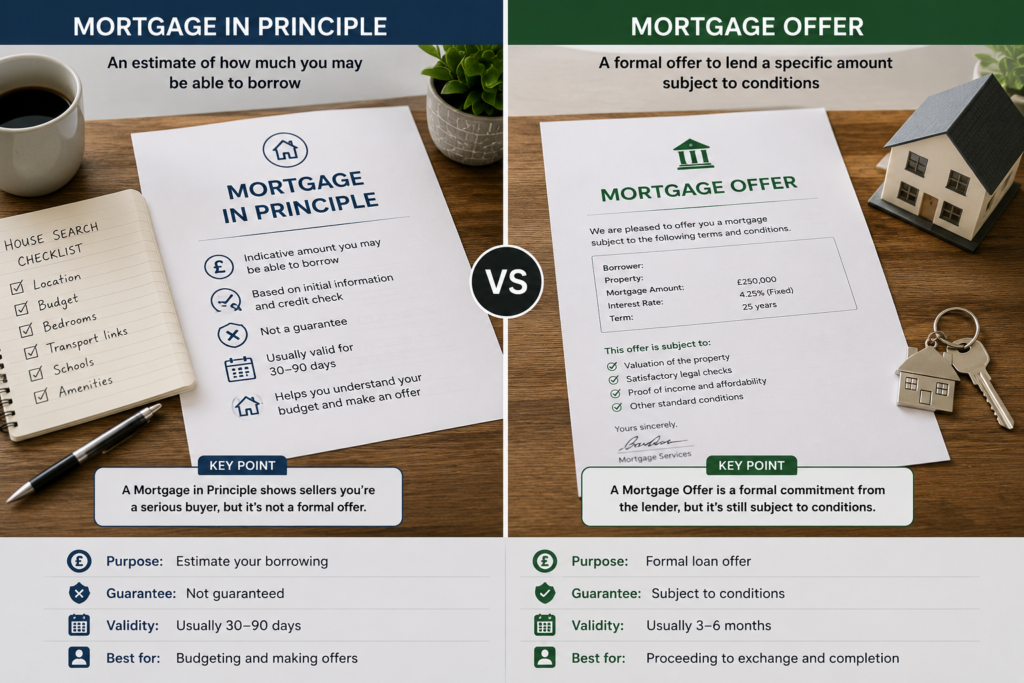
Mortgage in Principle vs Mortgage Offer
Although they’re related, a Mortgage in Principle and a Mortgage Offer serve different purposes.
| Mortgage in Principle | Mortgage Offer |
|---|---|
| Initial borrowing estimate | Formal mortgage approval |
| Based on basic financial checks | Based on full underwriting |
| No property valuation required | Includes property valuation |
| Not legally binding | Issued after lender approval |
| Helps you start house hunting | Lets you proceed towards exchange and completion |
Think of a Mortgage in Principle as the first step, while a Mortgage Offer is the lender’s formal agreement to lend on a specific property.
Tips to Improve Your Chances of Getting a Mortgage in Principle
Small improvements to your finances can strengthen your application before you apply.
Practical steps
- Check your credit report for errors.
- Register on the electoral roll if eligible.
- Reduce outstanding debt where possible.
- Save a larger deposit.
- Avoid applying for multiple credit products.
- Keep your income information accurate.
- Gather documents before starting your application.
- Consider using a mortgage broker if you’re self-employed or have a more complex financial situation.
Preparing in advance can improve your chances of receiving a Mortgage in Principle and make the full mortgage application process smoother.
Frequently Asked Questions
What is a Mortgage in Principle?
A Mortgage in Principle (MIP) is a lender’s initial indication of how much they may be willing to lend based on your financial information and an initial credit assessment. It is not a guaranteed mortgage offer, but it helps you understand your budget before you start looking for a property.
How long does a Mortgage in Principle last?
Most Mortgage in Principle certificates are valid for 60 to 90 days, although this varies by lender. If it expires before you find a property, you can usually apply for a new one, provided your financial circumstances haven’t changed significantly.
Does a Mortgage in Principle affect your credit score?
It depends on the lender. Some lenders use a soft credit search, which doesn’t affect your credit score, while others carry out a hard credit search, which is recorded on your credit file. Always check the lender’s policy before applying.
Can you be declined after getting a Mortgage in Principle?
Yes. A Mortgage in Principle isn’t a guarantee that your full mortgage application will be approved. Changes to your income, new borrowing, issues with the property valuation or differences in the information you provide can all lead to a lender declining your application.
Do you need a Mortgage in Principle before making an offer?
There’s no legal requirement to have a Mortgage in Principle before making an offer on a property. However, many estate agents and sellers prefer buyers who already have one because it shows they’re likely to be able to secure mortgage finance.
Sources & Methodology
This guide has been researched using official UK government, regulatory and industry sources available at the time of writing. Where lender-specific information is mentioned, such as Mortgage in Principle validity periods, application processes or credit search policies, it should always be verified with the relevant lender before applying, as requirements can change.
Primary sources used
- Bank of England (BoE) – Bank Rate, mortgage approvals and Money & Credit statistics.
- Financial Conduct Authority (FCA) – Mortgage Conduct of Business (MCOB) rules and consumer guidance.
- MoneyHelper – Independent guidance on mortgages, affordability and the home-buying process.
- GOV.UK – First Homes Scheme, Lifetime ISA, Stamp Duty Land Tax and other government guidance.
- HM Land Registry – House Price Index and property transaction data.
- Office for National Statistics (ONS) – Earnings, inflation, household income and housing affordability.
- UK Finance – Mortgage lending statistics and market reports.
- Experian UK, Equifax UK and TransUnion UK – Credit reports, credit searches and mortgage preparation guidance.
Disclaimer: The information in this guide is for general educational purposes only and should not be considered financial, legal or mortgage advice. Mortgage eligibility, affordability assessments, interest rates and lending criteria vary between lenders and may change over time. If you’re unsure which mortgage is right for your circumstances, consider speaking to a qualified mortgage adviser or independent financial adviser.
Editorial Policy: This article has been researched using official UK government, regulatory and industry sources. Learn more about our fact-checking process and editorial standards in our Editorial Policy.
Mortgage in Principle when remortgaging
You can also get a Mortgage in Principle when remortgaging, it works the same way as for a purchase, giving you a written indication of what a lender would offer before you commit to the full application. It is particularly useful if you are switching lenders, since your current lender’s product transfer is not your only option.
At the agreement-in-principle stage most lenders run a soft credit check, so shopping around between two or three remortgage offers will not damage your credit file. The hard search comes later, with the full application, so avoid submitting several full applications in parallel.
Mortgage in Principle for buy-to-let
Buy-to-let lending is assessed differently from residential borrowing. Instead of focusing mainly on your salary, lenders test whether the rental income will comfortably cover the mortgage payment, usually against a higher “stressed” interest rate than the one you will actually pay, to prove the loan stays affordable if rates rise.
Expect a larger deposit requirement than for a home you live in (25% or more is typical), and note that the affordability test is about the property’s yield, not just your personal income. A buy-to-let Mortgage in Principle therefore tells you which properties are financeable, which makes it a practical tool for filtering listings before you view them.
Got a UK money question?
Ask it in the Ask UKMT live chat. No sign up, no names, and the answers are checked against official sources. Open the live chat