
UK House Prices Flat in September: Lloyds Puts the Average Home at £298,441
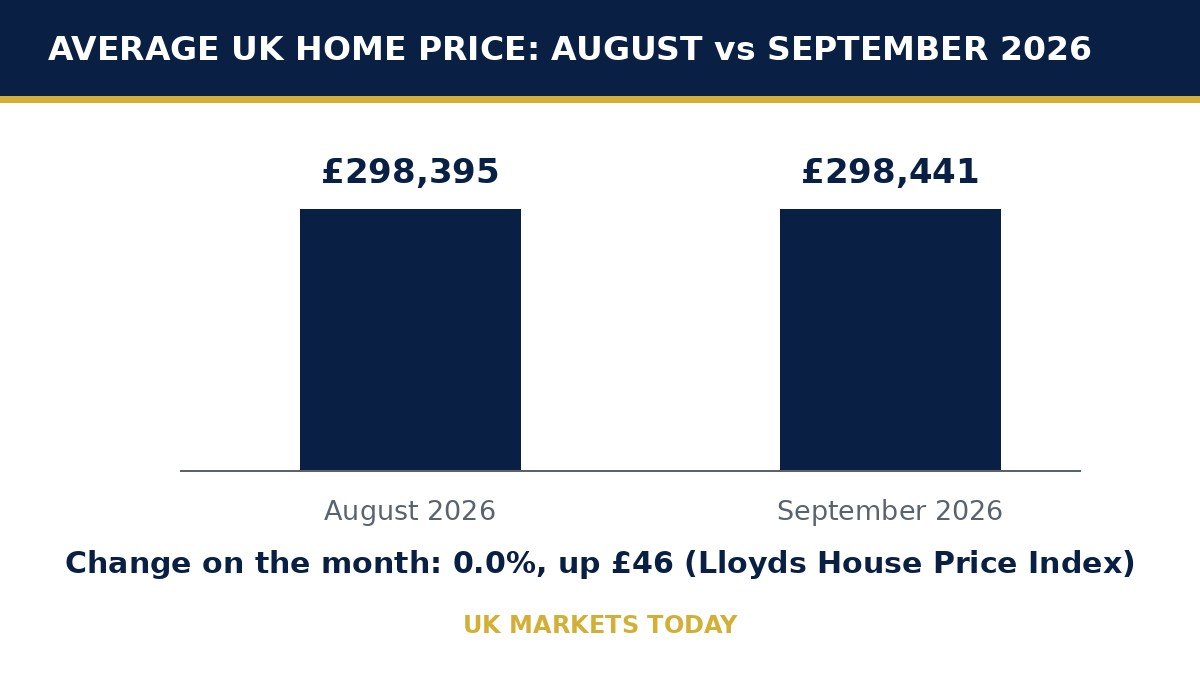
UK house prices were flat in September 2026 at an average of £298,441, according to the Lloyds House Price Index. What 0% growth means for buyers, sellers and remortgagers.

TL;DR: UK house prices did not move in September. The Lloyds House Price Index puts the average home at £298,441, up just £46 on August, with prices also flat over the year. For most households the story is not prices, it is the cost of borrowing.
What happened to UK house prices in September
Lloyds published its latest House Price Index on Wednesday 7 October 2026, covering September. Prices were unchanged on the month, at 0.0%, following a 0.3% fall in August. The annual picture was also flat, at 0.0%, after prices had fallen 0.4% over the year to August.
The index is the long running measure previously published under the Halifax brand and now issued by Lloyds, the UK’s largest mortgage lender group. It is based on Lloyds and Halifax mortgage approval data, so it tracks the prices buyers are actually paying with a mortgage, rather than asking prices.
Lloyds described the market as fairly subdued, but said prices have proved resilient during a period of higher mortgage rates. The lender linked those higher rates to changing expectations about the future path of the Bank of England Base Rate. It also reported that new enquiries from prospective buyers are at their highest level since February, while cautioning that any movement in prices is likely to remain modest in the near term.
| Measure | September 2026 | August 2026 |
|---|---|---|
| Average UK house price | £298,441 | £298,395 |
| Change on the month | 0.0% | minus 0.3% |
| Change on the year | 0.0% | minus 0.4% |
Figures: Lloyds House Price Index, published 7 October 2026. The September average is £46 higher than August on Lloyds’ own figures. Over the quarter (July to September), prices fell 0.2%.
The other main index this month: Nationwide
Lloyds is not the only lender that measures house prices. Nationwide published its September figures a week earlier, on 1 October 2026, and its index reads a touch softer: prices fell 0.2% on the month after seasonal adjustment, annual growth halved to 0.8%, the weakest since December 2025, and its average property price is £274,251.
Why the difference? Each index is built from that lender’s own mortgage approvals, so the sample of homes and buyers behind each average is different. Nationwide’s monthly change is also seasonally adjusted, while its average price is not. The two indexes disagree on the decimal point, not on the story: a flat, subdued market.
Figures: Nationwide House Price Index, published 1 October 2026.
What it means for your money
If you are saving to buy: a flat market works in your favour in one quiet way. Your deposit target is not running away from you. On the average home, a 10% deposit is £29,844 and a 5% deposit is £14,922, and those numbers barely moved this month. What decides your monthly payment now is the mortgage rate you can get, not rapid price rises.
If you are selling: flat prices nationally mean buyers have little reason to stretch. Homes priced for last year’s market can sit unsold while realistically priced homes on the same street still move. Enquiries are at their strongest since February according to Lloyds, so demand exists, but it is price sensitive.
If your fixed deal is ending: a flat market means your home’s value, and so your loan to value band, is broadly where it was. That band helps set the rate you are offered, so it is worth checking your options early rather than drifting onto a lender’s standard variable rate. Our remortgaging guide walks through the timing and the costs step by step.
If you are staying put: there is nothing to act on. A 0.0% month changes neither your payments nor your equity in any way you would notice.
The average home in numbers: deposit and monthly payment examples
These examples are our own calculations from the Lloyds average price of £298,441. They are illustrations with stated assumptions, not mortgage quotes.
| Example | Figure |
|---|---|
| 5% deposit on the average home | £14,922 |
| 10% deposit on the average home | £29,844 |
| Mortgage after a 10% deposit | £268,597 |
| Monthly payment at an example rate of 5%, 25 year term | about £1,570 |
| Monthly payment at an example rate of 6%, 25 year term | about £1,731 |
One percentage point on the rate changes the payment on that loan by about £161 a month, while a flat price changed the deposit needed by almost nothing. That is why, in a market moving sideways, shopping for the rate matters more than waiting for the price.
Saving the deposit is the slower part. Putting aside £300 a month reaches a £29,844 deposit in about 99 months, just over eight years, ignoring interest and any price changes. At £500 a month it takes about 60 months, or five years. A flat market at least means that target stays roughly still while you save.
UK house prices in September: your questions answered
Is 0% growth good news or bad news? It depends on where you stand. It is mildly good news for first time buyers, because deposits stop growing. It is neutral for most owners, whose equity is unchanged. It is frustrating for sellers hoping for a quick gain, and for anyone who needs prices to rise to move up the ladder.
Should I wait for prices to fall before I buy? Nobody can time the market, and this index gives no sign of a fall starting: prices rose £46 on the month and buyer enquiries are at a seven month high. A decision to buy usually turns on the deposit you have, the payment you can afford and how long you plan to stay, rather than on one month’s index.
Why do other house price indexes give different numbers? Each index measures something different. Lloyds and Nationwide track their own mortgage approvals, Rightmove tracks asking prices, and the official UK index tracks completed sales and lags behind. Small differences between them in any single month are normal.
Did UK house prices actually fall in September 2026? It depends which index you read. Lloyds says prices were flat, at 0.0% on the month. Nationwide says they fell 0.2% after seasonal adjustment. Both agree on the bigger picture: the market is broadly flat, with prices between 0.0% and 0.8% higher than a year ago depending on the index.
What is the average UK house price in September 2026? Lloyds puts it at £298,441 and Nationwide at £274,251. The £24,190 gap is method, not a mistake by either lender: each index is built from its own mortgage approvals, so the mix of homes and buyers behind the average is different.
How can I find out what my own home is worth? A national average is not a valuation of your street. The hardest evidence is completed sale prices, which anyone can check free on the Land Registry. Property portals give instant estimates from past sales, useful as a rough guide only, and two or three valuations from local estate agents will show you the spread buyers are likely to pay.
What happens next to house prices? We do not make predictions. Lloyds itself expects any movement to remain modest in the near term, and says confidence will play a big part in shaping demand for the rest of this year and into 2027.
Source: Lloyds House Price Index, Lloyds Bank media centre, published 7 October 2026. Deposit and payment figures are UK Markets Today calculations from the Lloyds average price, using the assumptions stated. Photo: colourful mews houses in London, via Pexels.
Got a UK money question?
Ask it in the Ask UKMT live chat. No sign up, no names, and the answers are checked against official sources. Open the live chat