
How Long Should I Fix My Mortgage For in 2027? 2, 5 or 10 Years Explained
By Deeraj Kiran | Published 9 November 2026 | Last checked: 9 November 2026 Every rate in this guide was checked on 9 November 2026, for fixing now into 2027. The Bank of England raised Bank Rate to 4% on 5 November 2026, up from 3.75%. The next Bank Rate decision is Thursday 17 December…

By Deeraj Kiran | Published 9 November 2026 | Last checked: 9 November 2026
Every rate in this guide was checked on 9 November 2026, for fixing now into 2027. The Bank of England raised Bank Rate to 4% on 5 November 2026, up from 3.75%. The next Bank Rate decision is Thursday 17 December 2026. Check the live table on our Mortgage Rates Today page before you act.
This guide gives general information only. It is not financial advice, and it is not a personal recommendation. Your home may be repossessed if you do not keep up repayments on your mortgage.
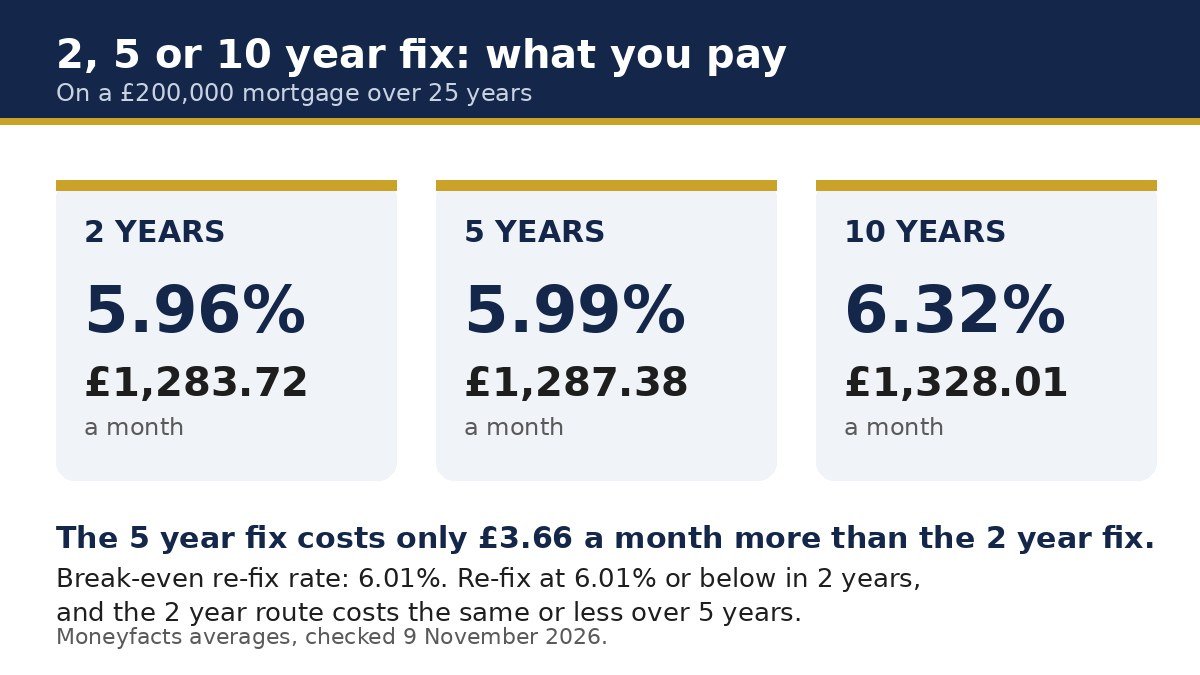
TL;DR, the quick answer. Our checks say: if you may move home within 2 years, take the shorter fix. If you will stay put and want your payment locked, the 5 year fix costs only £3.66 a month more than the 2 year fix. On a £200,000 mortgage over 25 years, the average 2 year fix at 5.96% costs £1,283.72 a month, and the average 5 year fix at 5.99% costs £1,287.38 a month. The number that decides it is 6.01%. Take the 2 year fix and re-fix at 6.01% or below in 2 years, and the 2 year route costs the same or less over 5 years. Above 6.01%, the 5 year fix wins. Do nothing when your fix ends, and the average variable rate of 7.13% would push that mortgage to £1,421.60 a month, £137.89 more.
What does fixing your mortgage actually mean?
Fixing means your interest rate stays the same for a set time, usually 2, 3, 5 or 10 years. Your monthly payment does not change in that time, even if Bank Rate moves up or down. When the fix ends, you move to your lender’s standard variable rate unless you pick a new deal first, and that rate is higher.
A short fix gives you freedom sooner. A long fix gives you certainty for longer.
What are the average fixed rates right now?
Average fixed rates in the UK on 9 November 2026 are 5.96% for a 2 year fix and 5.99% for a 5 year fix, from Moneyfacts data updated 6 November 2026. The average 10 year fix is 6.32%, and the average standard variable rate is 7.13%.
The gap between the 2 year and 5 year average is only 0.03 points.
| Deal | Rate | Fee | Source and date |
|---|---|---|---|
| Lowest 2 year fix, Yorkshire BS, 60% LTV | 4.90% | £1,495 | Moneyfacts, 6 Nov 2026, 6.4% APRC |
| Lowest 5 year fix, Nationwide, 60% LTV | 4.94% | £999 | Moneyfacts, 6 Nov 2026, 6.0% APRC |
| Best 2 year tracker, Barclays | 4.24% | See live table | Mortgage Advice Bureau, 9 Nov 2026 |
A warning about the Halifax 4.78% figure. Broker data updated 9 November 2026 lists Halifax 2 and 5 year fixes at 4.78% at 60% loan to value. We could not confirm that on Halifax’s own website, which says the Halifax brand is changing to Lloyds, and it is no longer taking new mortgage applications unless you have already started one.
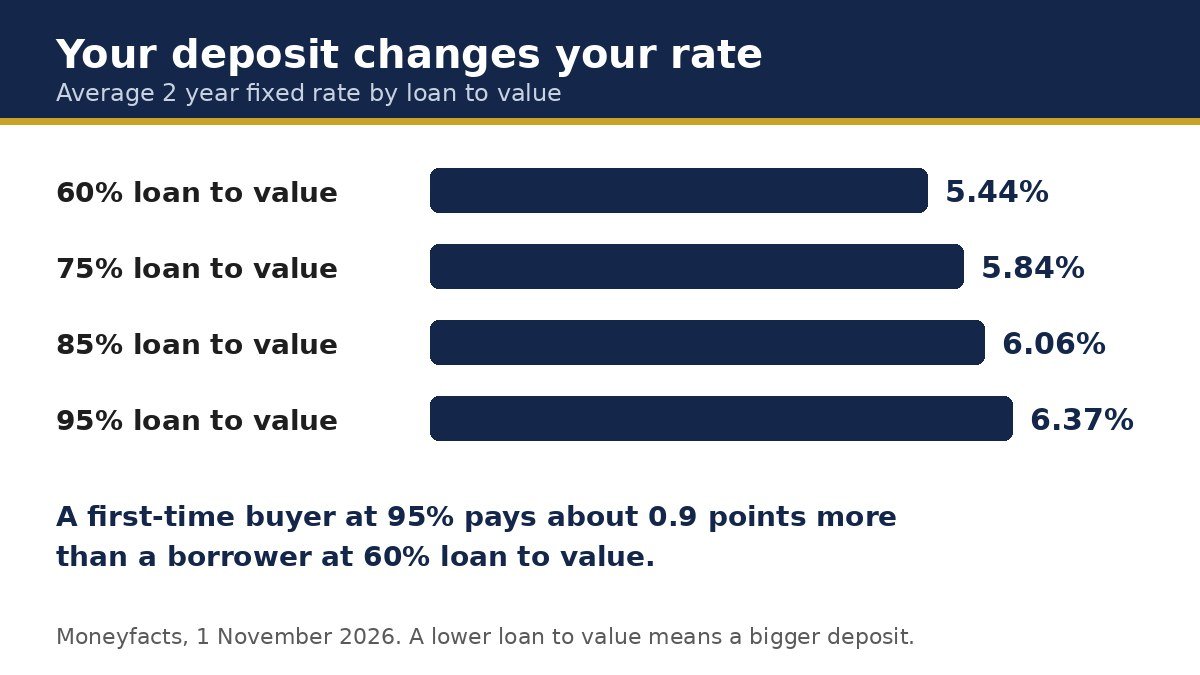
Rates also change with your loan to value, which is your loan as a share of your home’s value. Moneyfacts averages from 1 November 2026 for a 2 year fix are 5.44% at 60% loan to value, 5.84% at 75%, 6.06% at 85% and 6.37% at 95%. A first-time buyer at 95% pays about 0.9 points more.
How long should I fix my mortgage for, 2, 5 or 10 years?
There is no single right length. Pick 2 years if you may move, or if your loan to value will fall into a cheaper band within 2 years. Pick 5 years if you will stay put and want your payment locked for longer. Pick 10 years only if you will stay in the same home for a decade.
| Fix length | Average rate, 6 Nov 2026 | Payment on £200,000 over 25 years | Best for |
|---|---|---|---|
| 2 years | 5.96% | £1,283.72 | Moving soon, or waiting for a cheaper loan to value band |
| 3 years | No headline average checked | Not worked | Rarely best value. Which? found 3 year fixes the most expensive at higher loan to value bands, checked 13 October 2026. |
| 5 years | 5.99% | £1,287.38 | Staying put, and wanting your payment locked for longer |
| 10 years | 6.32% | £1,328.01 | Staying in the same home for a decade |
Three questions sort most people out. Will you move in the next 2 years? Can you cope if your payment rises when you re-fix? Will your loan to value fall into a cheaper band soon? First-time buyers at 90% or 95% loan to value often gain most from a 2 year fix. Remortgagers, movers and landlords should fix for the time they plan to stay.
What would I pay each month on a £200,000 mortgage?
Here is the worked example on one mortgage. The loan is £200,000 over 25 years, a repayment mortgage, which means each payment clears some interest and some of the loan. The rates are the Moneyfacts averages from 6 November 2026, with no fees added and no overpayments.
If you plan to overpay once you fix, work out the saving first with our Mortgage Overpayment Calculator: £200 a month on £200,000 at 5.96% saves £53,559.
At 5.96% on a 2 year fix, the payment is £1,283.72 a month. At 5.99% on a 5 year fix, the payment is £1,287.38 a month. The difference is £3.66 a month. Over the first 2 years, the 5 year fix costs £87.92 more in total: £30,897.13 paid against £30,809.21 on the 2 year fix.
The maths: the annual rate is 5.96%, so the monthly rate is 5.96% divided by 12, which is 0.49667%. Over 300 monthly payments, the payment is the loan times the monthly rate times 1 plus the monthly rate to the power of 300, divided by 1 plus the monthly rate to the power of 300 minus 1. The answer is £1,283.72 a month.
After 2 years on the 2 year fix, you still owe £192,617.85, having repaid £7,382.15 of the loan and paid £23,427.06 in interest. After 5 years on the 5 year fix, you owe £179,838.35, having paid £77,242.83 in total.
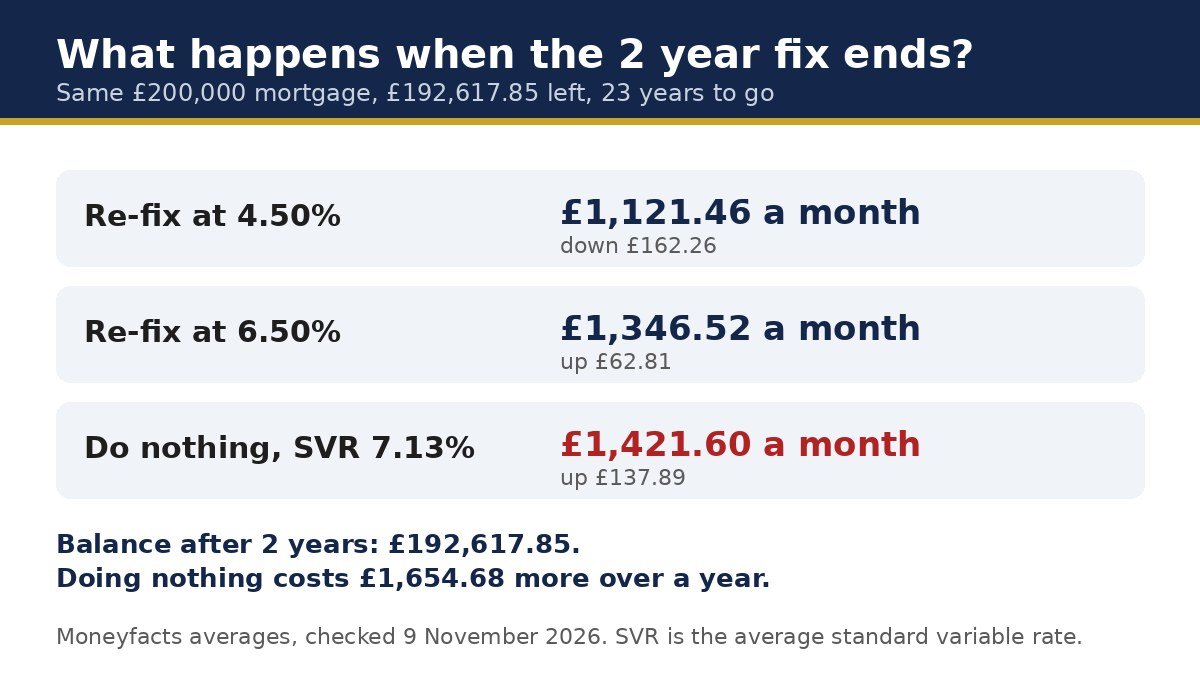
When the 2 year fix ends, you owe £192,617.85. Re-fix at 4.50% and your payment falls to £1,121.46 a month, down £162.26. Re-fix at 5.50% and it falls to £1,231.38, down £52.33. Re-fix at 6.50% and it rises to £1,346.52, up £62.81. Re-fix at 7.00% and it rises to £1,405.95, up £122.24.
What is the break-even rate, and why does 6.01% matter?
The break-even rate is 6.01%. That is the re-fix rate in 2 years at which the 2 year route and the 5 year route cost exactly the same over 5 years. Re-fix at 6.01% or below, and the 2 year route costs the same or less. Re-fix above 6.01%, and the 5 year fix wins.
Here are the inputs, so you can check the maths. The loan is £200,000 over 25 years, a repayment mortgage. The 2 year fix is 5.96% and the 5 year fix is 5.99%, both Moneyfacts averages from 6 November 2026. No fees are added, there are no overpayments, and the balance falls each month as you repay.
Over 5 years, the 5 year fix costs £77,242.83 in total. The 2 year route, with a new fix for years 3 to 5, costs £71,181.83 if you re-fix at 4.50%, which is £6,061.01 less. It costs £75,138.97 at 5.50%, which is £2,103.87 less. It costs £79,284.05 at 6.50%, which is £2,041.22 more. The UK Property Portal gives 5.06% on a flat balance that never falls.
What happens to my payment if I do nothing when my fix ends?
If you do nothing when your fix ends, your lender moves you to its standard variable rate. On the same £200,000 mortgage, with £192,617.85 left and 23 years to go, the average standard variable rate of 7.13% gives a payment of £1,421.60 a month. That is £137.89 a month more, or £1,654.68 more over a year.
That is the cost of doing nothing. Start looking about 6 months before your deal ends. MoneyHelper says you can lock in a new rate now without any commitment if your deal ends in the next 6 months. The average 5 year fixed rate was 2.25% in July 2021, according to Which?. Today it is 5.99%.
How much is the early repayment charge if I leave early?
The early repayment charge is the fee for leaving a fixed deal before it ends. It is charged as a share of the loan you still owe. Leave a 5 year fix after 3 years, when you owe £188,631.71, and a 3% charge is £5,658.95, which rounds to £5,659.
The balance after 3 years is £188,631.71, and 3% of that is £5,658.95. The charge is often highest in year one and falls each year, but the exact scale is in your mortgage offer. If you fix for 5 years and move in year 3, you either pay the charge, or you port the mortgage, which your lender has to agree to. If you have savings, an offset mortgage lets your savings cut the interest you pay.
Why can you trust the figures on this page?
Because every figure carries a date and a named source, checked after the Bank Rate rise. Five ranking pages still say Bank Rate is 3.75% on 9 November 2026, four days after it rose to 4%. Our figures are checked 9 November 2026, and Bank Rate is 4%, with the next decision on Thursday 17 December 2026.
We also show our working. The payments are recomputed from the standard repayment formula, not copied from another site. See our Mortgage Rates Today page, our Bank of England base rate explainer, our rates rising guide, our savings guide, and our Budget summary.
TRAP: drifting onto the standard variable rate. The most expensive trap in this guide is not picking the wrong fix length. It is picking no fix at all, and drifting onto your lender’s standard variable rate when your deal ends. On a £200,000 mortgage, the average standard variable rate of 7.13% costs £1,421.60 a month, against £1,283.72 on the average 2 year fix. That is £137.89 a month, or £1,654.68 a year, thrown away for doing nothing. The fix is a date in your calendar 6 months before your deal ends.
Frequently asked questions
What re-fix rate in 2 years would make the 2 year deal cheaper than the 5 year deal?
The break-even re-fix rate is 6.01%. Take the 2 year fix at 5.96% today: re-fix at 6.01% or below in 2 years, and the 2 year route costs the same or less than the 5 year fix at 5.99%. Above 6.01%, the 5 year fix wins.
How much is the early repayment charge in pounds if I leave a 5 year fix after 3 years?
On a £200,000 mortgage over 25 years at 5.99%, you owe £188,631.71 after 3 years. A 3% charge on that balance is £5,658.95, which rounds to £5,659. The charge usually falls each year, but the exact scale is in your mortgage offer.
What happens to my payment if I do nothing when my fix ends?
Your lender moves you to its standard variable rate. On a £200,000 mortgage with £192,617.85 left and 23 years to go, the average rate of 7.13% gives a payment of £1,421.60 a month, £137.89 a month more than the 2 year fix.
My loan to value is just above a cheaper band, should I take the 2 year fix?
Yes. A 2 year fix lets you remortgage into the cheaper band sooner, once 2 years of payments have cut your balance. At 60% loan to value the average 2 year fix is 5.44%, against 5.84% at 75% and 6.37% at 95%.
I might move in 2 years, what does porting actually require?
Porting means moving your mortgage to a new home with the same lender, and your lender has to agree to the new property. Extra borrowing needs a separate loan, so you end up with two mortgages, two rates and two end dates.
What if I get a lump sum, can I overpay without a charge?
Often, yes, up to a set amount each year. MoneyHelper says you can often pay extra, up to 10% a year, without a fee. Paying a lump sum cuts your balance, which cuts your interest. But the exact allowance is in your mortgage offer, so check it first.
Which is better, a 2 or 5 year fixed mortgage?
Neither is better for everyone. The 2 year fix suits you if you may move soon, or if your loan to value will soon fall into a cheaper band. The 5 year fix suits you if you will stay put and want your payment locked. At today’s rates the 5 year fix costs only £3.66 a month more.
What happens when my fixed rate ends?
Your lender moves you to its standard variable rate unless you pick a new deal first. That rate is usually higher. Start looking about 6 months before your deal ends. MoneyHelper says you can lock in a new rate now, without commitment, if your deal ends in the next 6 months.
Do this next, in this order
- Find your fix end date and your current rate. Write them down where you will see them.
- Work out your loan to value. Divide your loan balance by your home value, then multiply by 100.
- Run your own numbers with our Mortgage Calculator, using your balance, rate and term.
- Check the live rates table on our Mortgage Rates Today page, and note the fee on each deal.
- Ask your lender for the early repayment charge in pounds, and your overpayment allowance, before you sign.
- Set a date 6 months before your fix ends, and check rates again then. The next Bank Rate decision is Thursday 17 December 2026.
Your home may be repossessed if you do not keep up repayments on your mortgage. This guide is general information, not financial advice. For advice on your own situation, speak to a qualified mortgage adviser.
Sources
- Bank of England, Bank Rate 4%, raised 5 Nov 2026, next decision 17 Dec 2026. Checked 9 Nov 2026. Bank of England Bank Rate page
- Moneyfactscompare, fixed-rate mortgages, average 2 year fix 5.96%, average 5 year fix 5.99%, updated 6 Nov 2026. Checked 9 Nov 2026. Moneyfactscompare fixed-rate mortgages
- MoneyHelper, understanding mortgages and interest rates, overpayment allowance. Checked 9 Nov 2026. MoneyHelper mortgage interest rate options
- MoneyHelper, how will interest rates affect my mortgage, 6 month remortgage window, updated 5 Nov 2026. Checked 9 Nov 2026. MoneyHelper interest rates and your mortgage
- Which?, should you fix your mortgage for two or five years, updated 15 Oct 2026. Checked 9 Nov 2026. https://www.which.co.uk/news/article/should-you-fix-your-mortgage-for-two-or-five-years-apKbb2y71TIf
- Halifax, mortgages page, brand changing to Lloyds, no new mortgage applications unless already started. Checked 9 Nov 2026. https://www.halifax.co.uk/mortgages/
- Mortgage Advice Bureau data, 9 Nov 2026, via HOA best mortgage rates. Checked 9 Nov 2026. https://hoa.org.uk/best-mortgage-rates/
- r/UKPersonalFinance wiki, mortgages. Checked 9 Nov 2026. https://ukpersonal.finance/mortgages/
- UK Markets Today, Mortgage Rates Today, checked 9 Nov 2026. https://ukmarketstoday.co.uk/mortgage-rates-today/
Got a UK money question?
Ask it in the Ask UKMT live chat. No sign up, no names, and the answers are checked against official sources. Open the live chat
Follow UK Markets Today on Google
Get our latest guides in your Google feed: set UK Markets Today as a preferred source.