
Gifting to Parents UK 2026: How Much Money Can You Give Tax-Free?
TL;DR: Yes, you can gift money to your parents tax-free in the UK. There is no gift tax, and nobody pays tax on the day you hand the money over. You can give £3,000 a year under the annual exemption, or regular gifts from your spare income with no limit. Bigger gifts only matter for…

TL;DR: Yes, you can gift money to your parents tax-free in the UK. There is no gift tax, and nobody pays tax on the day you hand the money over. You can give £3,000 a year under the annual exemption, or regular gifts from your spare income with no limit. Bigger gifts only matter for inheritance tax if you die within seven years and your gifts plus your estate pass £325,000. Verdict: regular gifts from spare income are the safest route for most families, but check benefits first. A £20,000 gift can end a Universal Credit claim outright.
By Deeraj Kiran, Founder. Last updated: 11 November 2026. Figures checked against GOV.UK on 11 November 2026.
Can I gift money to my parents tax-free?
Yes. There is no gift tax in the UK, and your parents pay no income tax on a gift. Nothing is due on the day. Inheritance tax is the only tax that can reach back to a gift, and only if you die within seven years and your gifts plus your estate pass £325,000. Below that, no tax is due.
The tax question is not about the gift, it is about your estate. The UK has no tax on giving, only inheritance tax on what you leave behind, and gifts made in the seven years before you die can count towards that. Keep one thing apart: the tax on the gift and the effect on your parents. A gift can be free of inheritance tax and still cut their benefits, so read the benefits section before you send a lump sum.
How much money can I give my parents tax-free in the UK?
You can give £3,000 a year under the annual exemption, and carry one unused year forward, so up to £6,000 in a single year. On top of that you can give as many £250 small gifts as you like, one per person, and regular amounts from your spare income with no limit. A couple can give twice as much.
The allowances stack. Here is the full set, all from the GOV.UK rules on giving gifts.
| Allowance | Amount | Who it covers |
|---|---|---|
| Annual exemption | £3,000 per tax year | One person, or split between several |
| Unused annual exemption | Carry forward one year only | Up to £6,000 in a single year |
| Small gifts | Up to £250 per person, per year | Any number of people, but not the same person as another allowance |
| Wedding gift | £1,000 to any other person | Your dad remarrying, for example, plus your £3,000 on top |
| Regular gifts from income | No limit | Regular payments from surplus income, if you can still live as usual |
| Spouse or civil partner | No limit | Your husband, wife or civil partner |
Worked example: the couple’s catch-up gift. You and your spouse each have a £3,000 annual exemption, and neither of you used last year’s. This year each of you can give £3,000 plus £3,000 carried forward, which is £6,000 each. Together that is £12,000 to mum and dad, immediately exempt, with no seven-year clock. The tax year runs from 6 April to 5 April. A wedding gift works the same way: if your dad remarries, you can give £1,000 as a wedding gift plus your £3,000 annual exemption, £4,000 in that year.
What does this gift do to Mum and Dad?
This is the question no other guide asks, and it matters more than the tax. A gift becomes your parent’s savings the moment it lands in their account. If they claim a means-tested benefit, that extra savings can cut their payments, and a big enough gift can stop them altogether. Check their benefits before you send a lump sum.
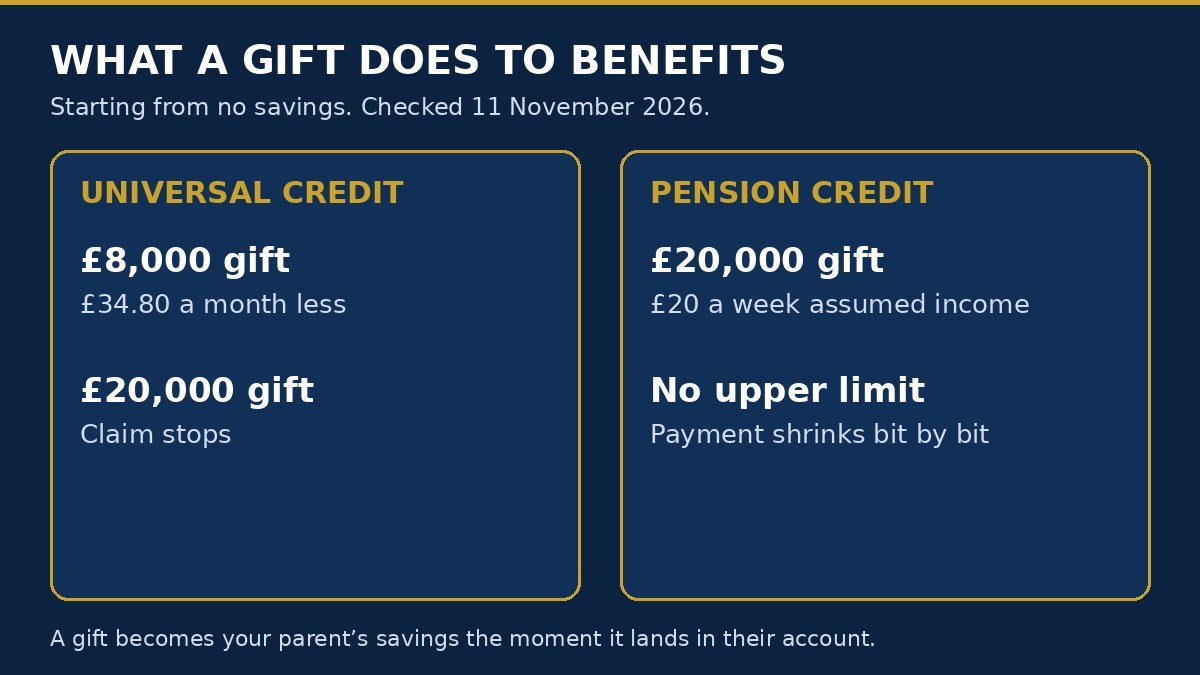
Universal Credit. Savings up to £6,000 have no effect. Between £6,000 and £16,000, the payment falls by £4.35 a month for every £250, or part of £250, over £6,000. Over £16,000, Universal Credit stops entirely. Those are the GOV.UK capital rules, checked 11 November 2026.
Worked example, starting from no savings. Your mum claims Universal Credit and has no savings. You give her £8,000. Her savings become £8,000, which is £2,000 over the £6,000 line. £2,000 divided by £250 is 8 parts, and 8 times £4.35 is £34.80. Her Universal Credit falls by £34.80 a month. Give her £20,000 instead, starting from no savings, and her savings become £20,000, over the £16,000 limit, so her Universal Credit stops entirely.
Pension Credit. The first £10,000 of savings is ignored. Above £10,000, every £500, or part of £500, counts as £1 of income a week. There is no upper limit that ends the claim, so a big gift shrinks the payment bit by bit instead of stopping it. Those are the GOV.UK Pension Credit capital rules, read directly on 11 November 2026. Pension Credit tops weekly income to £238 for a single person and £363.25 for a couple.
Worked example, starting from no savings. Your dad claims Pension Credit and has no savings. You give him £20,000. His savings become £20,000, which is £10,000 over the line. £10,000 divided by £500 is 20 parts, so £20 a week of assumed income is counted against his claim. A smaller total shows the same maths: £15,000 of total savings is £5,000 over the line, which is 10 parts, so £10 a week of assumed income.
| Universal Credit | Pension Credit | |
|---|---|---|
| Savings ignored | First £6,000 | First £10,000 |
| Over the line | £4.35 a month per £250, or part of £250 | £1 a week per £500, or part of £500 |
| Hard cut-off | Over £16,000, the claim stops | No upper limit, the payment shrinks bit by bit |
| £8,000 gift, from no savings | £34.80 a month less | No effect |
| £20,000 gift, from no savings | Claim stops | £20 a week assumed income |
Not every benefit works this way. Personal Independence Payment, Disability Living Allowance and Attendance Allowance are not means-tested, so a gift does not cut them. The same idea applies to care funding: if mum or dad later needs council-paid care, the council can treat money given away to avoid care charges as still theirs.
The safe way to help. If your parents claim a means-tested benefit, regular small amounts are usually safer than one lump sum, because each payment is spent on living costs instead of sitting as savings. If you do give a lump sum, tell the DWP as soon as it happens. Never ask a parent to give the money away again to keep a benefit: the DWP can treat them as still having it.
Interest the gift earns is your parent’s income to declare, and savings tax rises from 6 April 2027: our Autumn Budget 2026 hub has the new rates. If the gift will sit in savings, check the best savings rates today and the best cash ISA rates, where the interest is tax-free.
What is the seven-year rule for inheritance tax gifts?
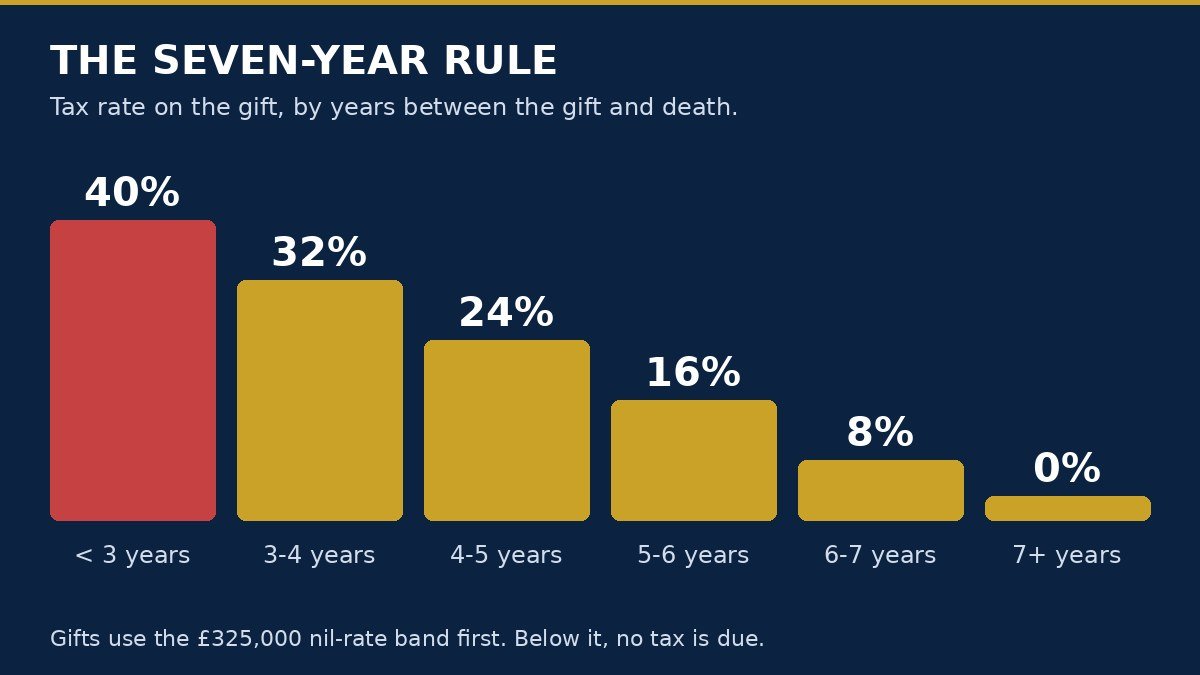
If you live for seven years after making a gift, no inheritance tax is due on it. If you die sooner, the gift counts back into your estate, and tax only falls on the part above the £325,000 nil-rate band. The rate slides down: 40% in the first three years, then 32%, 24%, 16% and 8%.
A gift over your exemptions is called a potentially exempt transfer. The clock starts on the day you make the gift, and gifts use up the £325,000 nil-rate band first, oldest first. The band has been frozen since 2009 and stays frozen until April 2031. Taper relief only helps once total gifts in the seven years pass the band. Rates from the GOV.UK gift rules; examples from GOV.UK’s guide to working out tax due on gifts.
| Years between gift and death | Tax rate on the gift |
|---|---|
| Less than 3 years | 40% |
| 3 to 4 years | 32% |
| 4 to 5 years | 24% |
| 5 to 6 years | 16% |
| 6 to 7 years | 8% |
| 7 years or more | 0% |
Worked example: the £50,000 gift that costs nothing. You give your parents £50,000, then die two years later. Your estate is £200,000. Gifts use the band first, so £50,000 plus £200,000 is £250,000 against a £325,000 band. That leaves £75,000 unused. Taxable amount £0. Tax due £0. The rule only bites when gifts plus estate pass £325,000.
Worked example: the £400,000 gift where the parents pay. You give £400,000 to your parents and die five years and six months later, with no other estate. The excess over the band is £400,000 minus £325,000, which is £75,000. At five to six years the taper rate is 16%, so £75,000 times 16% is £12,000, against £30,000 at the full 40%. Because the total gifts pass £325,000, your parents pay the £12,000, not your estate.
Who pays the tax if I die within seven years?
Usually your estate pays. The one exception matters: if the gifts you made in the seven years before death add up to more than £325,000, then anyone who received a gift in those seven years has to pay tax on their gift. Below £325,000 of gifts, your parents pay nothing, even if you die the next day.
Most people get this backwards. The common worry is that mum or dad will get a tax bill for the money you gave them. In practice the estate settles it, because the gift is counted as part of your estate first. The bill only lands on the recipient when the gifts alone use up the whole £325,000 band.
Can I give money to my parents every month?
Yes, and for most families this is the best way to help. Regular gifts from your surplus income are exempt from inheritance tax with no upper limit, as long as they are regular, come from your income rather than your savings, and leave you enough to live as usual. There is no seven-year clock on these gifts.
This is the normal expenditure out of income rule, with no £3,000 cap and no seven-year wait. Worked example. You take home £3,000 a month and spend £2,200 on living costs, leaving £800 spare. You send mum £200 a month by standing order, £2,400 a year, and it is immediately exempt. GOV.UK’s own example is £60 a month, £720 a year, plus the £3,000 annual exemption in the same year.
Set it up as a standing order so the pattern is obvious, and keep a note of your income and spending. To work out your spare income, use our take-home pay calculator. A regular payment also helps on the benefits side, because money spent on living costs does not pile up as savings in your parent’s account.
Do I pay Capital Gains Tax if I gift something that is not cash?
Yes, you might. Giving away an asset counts as selling it for Capital Gains Tax, even though no money changes hands. You are treated as if you sold it at its market value on the day you gave it away. Cash is different: handing over cash never triggers Capital Gains Tax.
This catches people who gift a second property, shares or a valuable item. If the asset has gone up in value, the gain is the market value on the day of the gift minus what you paid. The annual exempt amount is £3,000 for individuals, and the rates are 18% for basic rate taxpayers and 24% for higher and additional rate taxpayers, from 2025/26 onwards. Hold-over relief can delay the gain for business assets, unlisted shares in a trading company and agricultural land, but you and the recipient must claim it together. A gift to your husband, wife or civil partner is exempt. Gift residential property and you must report it and pay the tax within 60 days. The rules are in HMRC helpsheet HS295 on relief for gifts.
One more catch: a gift with reservation. If you give something away but keep using it, for example living in a house you gave to your parents, it still counts towards your estate. Give it away properly, or do not give it away.
Should I gift money to my parents or lend it to them?
Gift it if you can afford never to see it again, and lend it if you might need it back. A gift leaves your estate and, after seven years, leaves the tax picture too. A loan stays yours, so it stays in your estate, but you can ask for it back. The choice depends on whether the money is spare.
| Gift | Loan | |
|---|---|---|
| Is it yours any more? | No, it belongs to your parent | Yes, they owe it back to you |
| Inheritance tax | Out of your estate after seven years | Stays in your estate |
| Your parent’s benefits | Counts as their savings | Usually still counts as their capital while they hold it |
| Can you get it back? | No | Yes, if you agree terms in writing |
| Paperwork | Keep a note of what, who, when | Write down the amount, the date and the repayment plan |
If you lend, write it down. A loan with no paperwork looks exactly like a gift to everyone who checks later: the taxman, the DWP and the council. If you gift, be sure you can afford it: money given away is money you cannot use for your own emergencies.
Do I need to declare cash gifts to HMRC?
No, there is no form to fill in and no payment to make on the day. The person sorting out your estate is the one who needs the records, and only if you die within seven years. Keep a note of every gift: what you gave, who got it, what it was worth, and when you gave it.
Your bank may still ask questions. A large transfer can trigger a source-of-funds check, so keep the paper trail: the date, the amount, and a short note saying it was a gift to your parents. If the money came from a house sale or an inheritance, keep that document too.
The trap: £3,000 is an exemption, not a limit
Here is the mistake that causes the most worry, stated flatly in some guides: that if you die within seven years of giving a gift, the tax-free threshold is £3,000. That is wrong, and it scares families for no reason.
£3,000 is the annual exemption. It is taken off the value of a gift whether or not you die within seven years. What actually happens inside seven years is that the gift becomes a potentially exempt transfer and uses up the £325,000 nil-rate band first. Tax only falls on the part above £325,000. A £10,000 gift to mum is not taxable because you died within seven years. For most families it is not taxable at all, because their gifts plus their estate never reach £325,000. The £50,000 example above proves it: a £50,000 gift, death two years later, tax due £0.
The second half of the trap is the one this guide is built around. Families check the tax and forget the benefits. A gift that costs nothing in inheritance tax can still cost your mum her Universal Credit. Check the benefits first, then the tax. That order saves real money.
Frequently asked questions
Do I pay tax on money gifted to me in the UK?
No. The person who receives a cash gift pays no income tax on it, and there is no gift tax in the UK. The only tax that can reach a gift is inheritance tax, paid by the giver’s estate, not the recipient. Interest the gift earns afterwards is the recipient’s income to declare.
How much can you gift a family member tax-free in the UK?
£3,000 a year under the annual exemption, up to £6,000 if you carry one unused year forward, plus as many £250 small gifts as you like and regular gifts from surplus income with no limit. A couple can give £6,000 a year, or £12,000 in a catch-up year. Larger gifts are potentially exempt, tax-free if you live seven years.
What happens if I die within 7 years of gifting money?
The gift is counted back into your estate. Tax only falls on the part above the £325,000 nil-rate band, at 40% in the first three years, then 32%, 24%, 16% and 8%. Below £325,000 of gifts plus estate, no tax is due. Your estate usually pays; your parents only pay if the gifts alone pass £325,000.
Does gifting money to parents affect their benefits?
Yes, if they claim a means-tested benefit. A gift becomes their savings. On Universal Credit, savings over £6,000 cut the payment by £4.35 a month per £250, and over £16,000 the claim stops. On Pension Credit, the first £10,000 is ignored, then every £500 over counts as £1 a week. PIP, DLA and Attendance Allowance are not affected.
Do this next, in this order
- Check whether mum or dad claims Universal Credit, Pension Credit or Housing Benefit, and work out the effect before you send it.
- Choose the shape: regular monthly help from spare income is safest for most families.
- If it is a lump sum, use your £3,000 annual exemption first, and carry forward last year’s unused exemption if you have it.
- Send it by bank transfer, not cash, and keep a note of the date, amount and recipient. Keep seven years of records.
- If the gift will sit in savings, put it where it earns: check the best savings rates today.
- If either parent claims a benefit, tell the DWP about the change as soon as the money lands.
- For total gifts over £325,000, or for property and shares, talk to a solicitor or tax adviser first. This guide is general information, not personal advice. More tools are on our free UK money tools page.
Sources: GOV.UK, Rules on giving gifts, Inheritance Tax; GOV.UK, Work out Inheritance Tax due on gifts; GOV.UK, Universal Credit: what you’ll get; GOV.UK, Pension Credit: eligibility; HMRC helpsheet HS295, Relief for gifts and similar transactions. All figures checked 11 November 2026. This guide is general information, not regulated financial advice.
Got a UK money question?
Ask it in the Ask UKMT live chat. No sign up, no names, and the answers are checked against official sources. Open the live chat
Follow UK Markets Today on Google
Get our latest guides in your Google feed: set UK Markets Today as a preferred source.